
The Gothic Past and its Modern Renaissance
By Zoe Lambe, 3rd Year History
In recent years, pop culture has seen a resurgence of the Gothic. Whether this is in adaptations of original Gothic literature or new stories, there has undeniably been an eruption of Gothic films as of late, think Frankenstein (2025), Nosferatu (2024), or Sinners (2025). Gothic fashion is also having somewhat of a revival. Leading fashion magazines such as Vogue and Marie Claire have coined the terms ‘baby goth’ and ‘soft goth’, positioning visibly dark makeup as the answer to the ‘clean girl’ trend. Classically goth music still resonates with young listeners, as we can tell by The Cure’s Robert Smith making an appearance during Olivia Rodrigo's Glastonbury set, but ‘darkwave’ music has also gained traction in the last few years. Society seems to be welcoming this darkness with open arms, but it begs the questions: where did ‘goths’ emerge from, and what has brought them back out of the shadows?
The original ‘Goths’ were a Germanic tribe, who are probably most famous today for their sacking of Rome in 410 A.D. Following the downfall of the Western Roman Empire, two Gothic kingdoms arose, the Visigoths and the Ostrogoths. The Gothic tribes themselves didn’t have much of a tradition of writing their own histories, and so most of the source material discussing them comes mostly from Greco-Roman historians, many of whom were hostile towards the Goths due to their often bringing severe disruption to the empire. Their tribal society evolved continuously and lacked a stable monarchy or fixed social system, as frontier societies quite often do. Some historians have debated the extent to which the people sources describe as ‘goths’ would have even characterised themselves as such. In general, throughout history, they have mostly simply been characterised as ‘barbarians’ and are occasionally credited with preserving elements of Roman culture.
Why, then, did ‘Gothic’ come to be associated with the ornate and sophisticated architecture we now use it to describe? Late Renaissance Italian writers were the next people to use the word ‘Gothic’ and coined it as a term to describe this architectural style. It originated in the 12th Century in France, initially in architecture and later in sculptures, textiles and painting. Italian writers describing this intricate style as ‘Gothic’ meant it to be derogatory, deeming the style unrefined, ugly and reminiscent of the Gothic tribes in that it opposed Roman architectural traditions, like they had opposed Roman rule. Despite the disdain of these scholars, Gothic architecture had been popular across parts of Europe during the High Medieval period, and several original Gothic cathedrals are still architectural landmarks across Europe today.
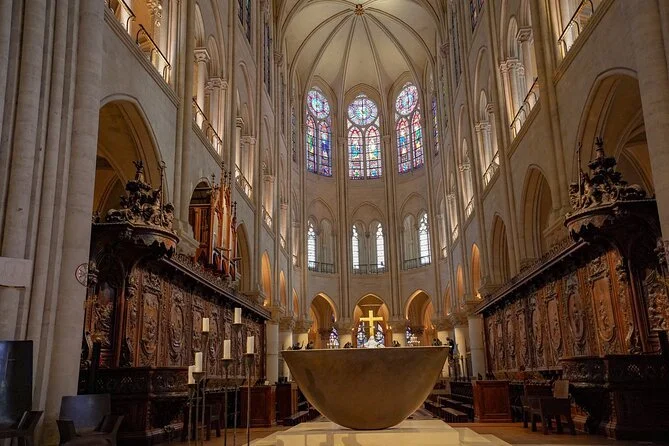
Inside Notre Dame Cathedral in Reims, France (Credit: TripAdvisor)
Although Gothic architecture fell out of fashion during the Renaissance, it had a resurgence in the mid-18th century. Appreciation for the sublimity and melancholia of Gothic architecture had grown in the centuries following the Renaissance, and architects were once again keen to evoke emotion through the aesthetic of their buildings. In this, they were certainly successful. Horace Walpole’s The Castle of Otranto (1795) is often considered the first Gothic novel, and Walpole claims he was inspired by a dream he had of an ancient castle.
Key Gothic literature which followed The Castle of Otranto includes Frankenstein (1818), Wuthering Heights (1847) and Dracula (1897), alongside many others. What characterises these novels as gothic is their wild and dark characters, uncanny plots and creepy environments – oftentimes medieval castles. These novels set the tone for interpretations of ‘gothic’ which have succeeded them with their motifs of darkness, and a preoccupation with death and transgression. What’s more, their themes often deliberately commented on the social fears of Victorian society. Dracula, for example, which migrated to England from Transylvania, represented the fear of globalisation, and Jekyll and Hyde (1886) explores how repression could result in a descent into madness.
Gothic literature evolved into Gothic cinema in the 20th century, keeping it within public consciousness. German expressionism borrowed the visual codes of eerie settings, shadows and distortion and film editions of traditional Gothic tales were produced. First with Frankenstein in 1910, then Jekyll and Hyde in 1912. A cultural appetite for darkness remained throughout the 20th century. The Addams Family sitcom (1964) adopted an aesthetic which we would nowadays see as gothic, albeit in a campier way.
However, the modern goth subculture we recognise today mainly emerged out of an appreciation for post-punk musicians in the 70’s, such as Siouxsie and the Banshees, Joy Division, The Cure and Sisters of Mercy. Their music evoked a similar macabre mood to Gothic fiction. Often being characterised by heavy drumbeats, rock guitars and contrasting voices, a low register male and a high female tone. Fans of this music adopted a haunting aesthetic that we now refer to as ‘trad goth’. They borrowed from Victorian mourning aesthetics, with pallid skin tones and wearing lace and long coats, but their overlap with punk fashion meant they also had obviously artificially dyed hair, dark eye makeup, mohawks and often wore PVC and fishnet tights. The umbrella term of ‘goth fashion’ encapsulates variants of this aesthetic, such as ‘cyber goth’, which was more futuristic and the more modern ‘pastel goths’.
Initially, ‘goths’ seemed to be another transitory youth subculture, but it has endured remarkably well. Goth fashion expanded across England, particularly into post-industrial Northern cities. Margaret Thatcher’s ascension to power led to violence breaking out on the streets, and perhaps young people desired a subculture which would reflect this disquiet. There are still meetings for Goths across the UK; Whitby Goth Weekend is arguably the biggest one. It is a festival where Gothic people can come together to celebrate predominantly Gothic music, but also the literature, fashion and culture.

Jenna Ortega in Wednesday (2022) (Credit: Netflix)
So, what is bringing gothic aesthetics back into mainstream consciousness? Revivals of older Gothic television like Wednesday (2022) and Beetlejuice Beetlejuice (2024) have propelled Gothic celebrities to the forefront, with Jenna Ortega being one of the faces of the movement. Alongside her are doppelgangers, Amelia Gray Hamlin and Gabriette, as well as older Gothic style icons like Catherine Zeta Jones. High-end fashion houses are also promoting the trend, and Gothic motifs are visible in Chanel and Vivienne Westwood pieces as of late. Gothic elements are becoming increasingly visible across music: Ethel Cain’s visuals and music are eerie and often comment on social issues as the original Gothic literature did, even Sabrina Carpenter's Taste music video embraced Gothic tropes.
The Gothic has historically referred to or been in response to periods of uncertainty, rapid change and cultural anxiety. The cost-of-living crisis and unstable job market could be resulting in this cultural turn towards the melancholic. Or perhaps people's increasing loss of faith in their governments has drawn them back towards an aesthetic which feels rebellious. Alternatively, it might just be the natural trend cycle, after years of ‘quiet luxury’ and ‘clean girl aesthetics’ - people are simply bored. Either way, Goths are rising once again, proving that their principles will always resonate with the public.
Edited by Charlotte Wyatt