Liberty or Death: A Freedom Denied
By Lucy Ward, 2nd Year History and Spanish
On 23 March 1775, Patrick Henry delivered one of the most famous speeches in American history to a packed audience at the Second Virginia Convention. The speech was a pivotal moment in shifting the Virginian position to one of armed resistance on the eve of the Revolutionary War. For centuries, Henry's closing line, “Give me liberty or give me death!” has been used as a rallying cry for freedom and resistance.
However, the contradiction in Henry's speech is clear: “liberty” would not apply to all Americans. In 1775, there were approximately half a million African Americans enslaved in what would become the United States. A slaveholder himself, Henry referred to the struggle for American independence as “nothing less than a question of freedom or slavery”. Yet enslaved people in America would not benefit from this fight for freedom.
For enslaved people, the phrase “Give me liberty or give me death” held a very different meaning. Whilst white leaders of the Revolution used it to resist taxation and oppose British imperial rule, enslaved people's struggle for liberty was a struggle for basic autonomy and recognition as people, rather than property. Far from achieving liberty with independence, the enslaved population would expand rapidly following the Revolutionary War, eventually reaching almost four million on the outbreak of the Civil War in 1861.
In many ways, enslaved people reinterpreted and embodied Henry's words in their own fight for liberty. Throughout the Revolutionary War, thousands of enslaved people fled slavery and joined the fight on the side of the British, who promised freedom. Others joined the Patriot cause after being promised freedom by their enslavers, although few kept that promise. Whatever choice they made, thousands of Black people who fought in the Revolutionary War knowingly faced death in their pursuit of liberty.
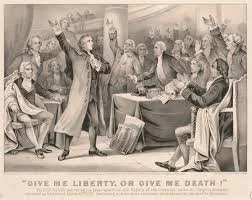
Patrick Henry’s 1775 “Give me liberty, or give me death!” speech, depicted in a 1876 lithograph by Currier and Ives.
As the institution of slavery expanded with the explosion of the domestic slave trade in the nineteenth century, countless enslaved people pursued liberty by fleeing bondage. This act, known as fugitivity, represented one of the most crucial forms of resistance. The decision to escape involved incredible risk, with severe consequences for fugitives who were caught. In choosing to escape, countless enslaved people reappropriated Henry's words with great significance.
Harriet Tubman, who escaped to the North in 1849, declared, “I had reasoned this out in my mind; there were one of two things I had the right to, liberty or death; if I could not have one, I would have the other.” A prominent abolitionist and conductor of the Underground Railroad, Tubman helped to rescue approximately seventy others from bondage.
Liberty or death for Tubman meant far more than fighting for freedom from imperial rule. Her words highlight the brutal reality that enslaved people continued to face decades after Henry's original speech and the uncompromising decision enslaved people had to make. To stay in slavery was to accept a lifetime of forced labour, inhumane treatment, and family separation; to attempt escape was to risk capture, punishment, or death.
Enslaved people were not merely echoing revolutionary rhetoric; they were enacting it under far harsher conditions. In his renowned 1845 narrative, Frederick Douglass makes a striking comparison between enslaved Black and free white people's experience of liberty or death:
“In coming to a fixed determination to run away, we did more than Patrick Henry, when he resolved upon liberty or death.”
Douglass's comparison reminds readers that the stakes were far higher for enslaved people in their pursuit of liberty. Fugitivity was more than rejecting a government: it was resistance against an entire social, economic, and legal order, and a claim to personhood itself. Whilst Henry called for the defence of political rights, enslaved people fought to become right-bearing individuals in the first place. Unlike Henry, a respected white politician acting within a political framework of resistance, enslaved people had nothing to fall back on, and their resistance faced consequences that were violent and even fatal.
On the anniversary of Henry's speech, it is important to recognise not just what was said but also who was left out. Patrick Henry's speech is often taught and remembered as a symbol of courage and patriotism, but it is also a reminder of the complexities and contradictions of history. The words “Give me liberty or give me death” did not solely belong to the revolutionary elite; through struggle and resistance, enslaved people claimed them as their own, transforming their meaning from one of colonial defence to a much greater demand for human freedom.
By reclaiming and redefining the language of the Revolution, enslaved people both exposed its limitations and expanded its meaning. Today, Henry's speech encourages us to remember those who have been excluded from grand narratives and how those same people challenged that exclusion, using the very language of liberty to redefine its meaning.
edited by Samuel Aylwin