
‘Highwayman’ to heavyweight: Who is Hemedti the Commander of the RSF?
By Kedric Morgan, 1st Year Politics and International Relations
Content Warning : This article contains discussions of sexual violence
Many have been made aware of violence in Sudan recently, when videos emerged showing armed Rapid Support Forces (RSF) troops executing several unarmed individuals in the recently captured city of El-Fashir, the state capital of North Darfur. This has been the latest instalment of a conflict going back nearly 40 years, one that has repeated the pattern of ethnic cleansing against Fur, Zaghawa, and other non-Arab communities. A constant figure since the militia (known as the janjawiid) appeared in Darfur has been Mohamed Hamdan Dagalo, better known by the nickname Hemedti, a sobriquet for ‘little Mohamed’.
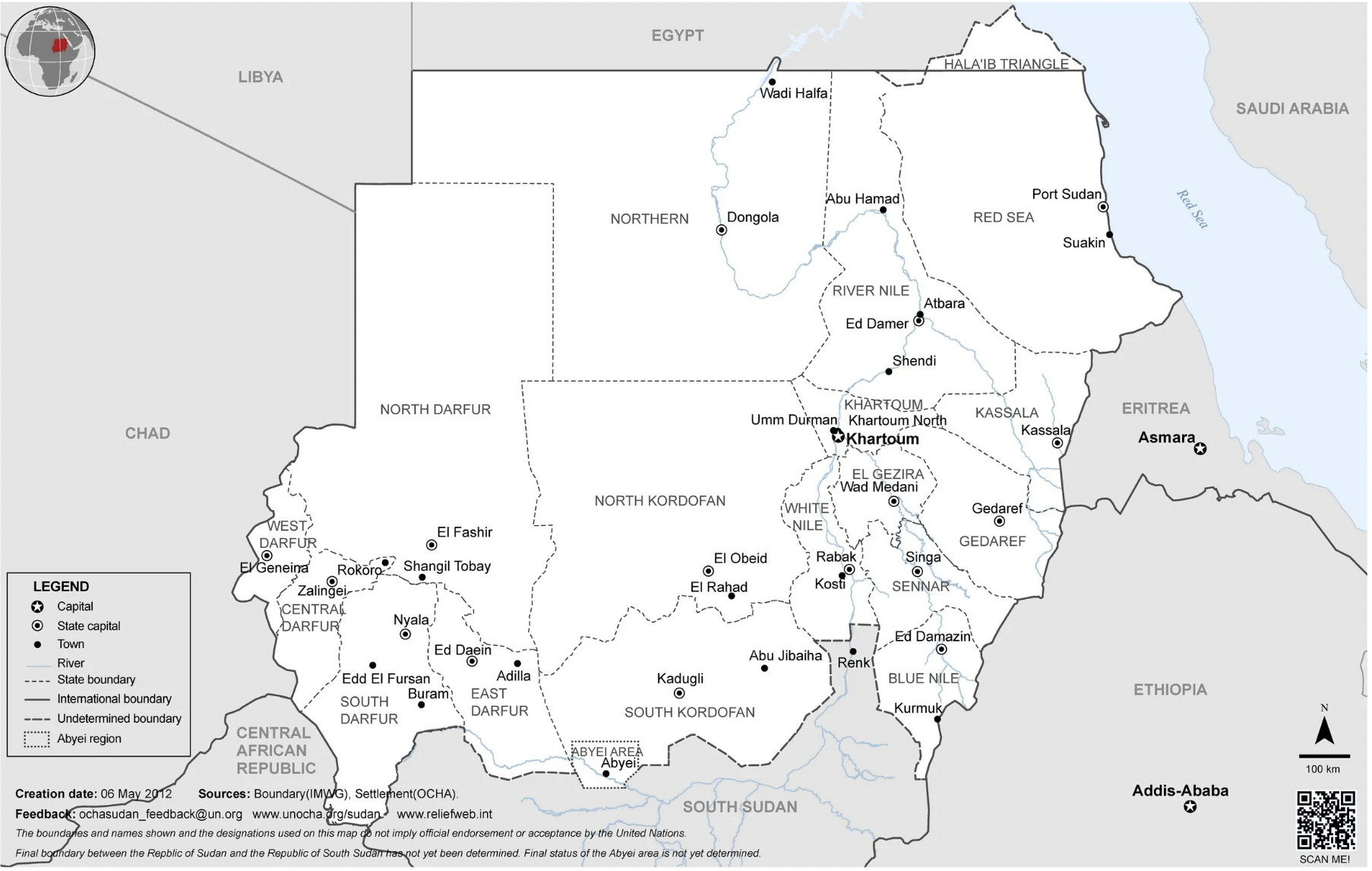
Map of Sudan, Image Credit: United Nations Office for the Coordination of Humanitarian Affairs, 2012
Hemedti first rose to political prominence in 2019 when he was appointed deputy chair of the Transitional Military Council, formed in the wake of the military-led overthrow of Sudan's longtime president, Omar al-Bashir. Until this point, Hemedti’s political trajectory had been directly tied to the fate of his patron, al-Bashir; the RSF had been functioning as a praetorian guard for al-Bashir. Since its creation, it has transformed from a paramilitary organisation used to control dissent and rebellion, most prevalent in Darfur, into a parallel force designed to ‘coup-proof’ al-Bashir from both the Sudanese Armed Forces (SAF) and the National Intelligence and Security Service (NISS). This was made overt in 2017 when al-Bashir moved the RSF from underneath the control of the NISS to directly under the Office of the President.
The RSF was initially formed mostly of ex-janjawiid fighters drawn from Hemedti’s Mahariyya tribe, though it later expanded through localised recruitment tied to land and resource arrangements. The forces known as the janjawiid were made up of various paramilitary groups within Darfur, most notably the Border Intelligence Brigade, of which Hemedti was initially an amir (a war chief without formal rank). There had been conflict between Fur, Masalit, and Zaghawa communities and janjawiid militias in the years preceding the Darfur civil war, but the formation of the Sudanese Liberation Army (SLA) in 2001 marked a decisive turning point that ushered in a phase of systematic militia violence backed by the Sudanese state and denounced by experts as genocide.
The Rapid Support Forces and their allies today represent a wide ethnic makeup (excluding the senior leadership); the janjawiid were initially dominated by the Abbala Rizeigat, a nomadic trans-Sahelian camel-herding group. Hemedti is a member of the Awlad Mansour clan, with his uncle Juma Dagalo serving as an omda (a middle-ranking administrative chief). Initially a camel trader, or a highwayman (according to one local Darfurian), he was first approached by Military Intelligence after 3,400 camels and 77 people were kidnapped from one of his caravans by Zaghawa militants, including ten of his relatives. He subsequently received military training and was charged with securing the area around Nyala, the state capital of South Darfur.
A few years later al-Bashir turned his support to Hemedti, now Security Advisor to the Governor of South Darfur, after the regime’s long-standing proxy in Darfur, Musa Hilal, came to be seen as increasingly unreliable. In 2013, al-Bashir created the Rapid Support Forces under the control of the NISS, appointing Hemedti as operations commander. The RSF proved little different from its predecessors, becoming infamous for burning villages, raping women and children, and forcibly displacing non-Arab communities during its campaigns in Darfur, most notably Operations Decisive Summer I and II in 2014 and 2015. RSF fighters were issued NISS identification cards, granting them effective immunity under the National Security Services Act of 2010.
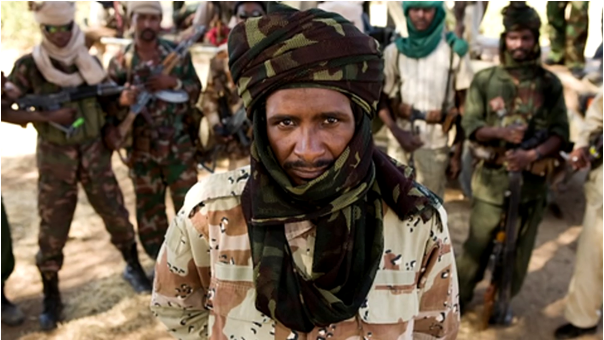
Hemedti with armed RSF troops, Image Credit: Andrew Carter
For the next four years, Hemedti consolidated both economic and military power, forging close relationships with the United Arab Emirates (UAE) and Saudi Arabia. The relationship between Hilal and al-Bashir finally collapsed in 2017 when Hilal was arrested by the RSF for refusing government access to gold mines under his control, al-Bashir consequently allowed Hemedti to seize control of the pits at Jebel Amir. The RSF came to dominate large portions of Sudan’s gold-producing regions in Darfur and Kordofan, by smuggling their output to Dubai for processing they became increasingly financially independent from the Sudanese state. This autonomy transformed the RSF from a regime tool into a rival centre of power, enabling Hemedti to play a decisive role in al-Bashir’s eventual removal.
These connections with the UAE have endured, with Abu Dhabi reportedly backing the RSF in its ongoing conflict with the SAF. In 2015, RSF forces were deployed to Yemen alongside SAF units to fight the Houthis rebels, but unlike their counterparts the RSF troops were placed on front lines and rewarded directly – allowing Hemedti to effectively exchange Khartoum for Abu Dhabi as his primary sponsor. The experience hardened his forces militarily and combined with their independent financing, positioned the RSF as an optimal political actor.
Al-Bashir was subsequently overthrown in 2019, with Abdel Fattah al-Burhan, commander of the SAF, and Hemedti emerging as chair and deputy chair, respectively, of the Transitional Sovereignty Council. Although not its formal leader, Hemedti was widely regarded as the council’s most powerful figure, with foreign delegations frequently seeking him out directly in the aftermath of the coup. The council was dissolved in 2021 and replaced by a military junta. Underlying tensions over the proposed integration of the RSF into the regular armed forces, which threatened Hemedti’s autonomy and economic base, remained unresolved and culminated in open conflict between the RSF and SAF on 15 April 2023. The war has since devastated Sudan, displacing millions and killing tens of thousands, with some estimates placing the toll far higher.
Alexander de Waal has described Hemedti as a ‘wholly twenty-first-century phenomenon: a military-political entrepreneur’ (2019). Today Hemedti controls vast swathes of Darfur through the RSF, including key border regions with Libya and Chad. His rise is not an aberration, but the culmination of decades of state-sponsored militia governance in Sudan, which has impacted millions of lives in the name of control.
To read more on the RSF and janjawiid, see:
https://www.smallarmssurvey.org/sites/default/files/resources/HSBA-WP-17-Beyond-Janjaweed.pdf
Flint, J. and De Waal, A. (2008). ‘Darfur: A Short History of a Long War’. 2nd edn. Zed Books.
Edited by Bea Vivian