The Role of Women in the Founding of University College Bristol
By S. Giraldo, 3rd Year History and Russian
University College, Bristol (‘UCB’ or ‘the College’) was the first college in England to offer education to ‘persons of both sexes above the ordinary school age’.[1] In UCB’s first session, 174 women attended lectures – almost half the total intake. Women’s organisations were instrumental to the initial success and continued existence of the College, as it was threatened by financial problems in the 1880s.
To people at the time, the central role of women was evident, as we can see from the letters they left behind. Histories produced in the first quarter of the 20th century, focused on the biographies and personal experiences of people like Catherine Winkworth and Bishop John Percival.[2] These early histories relied on contemporary letters, the accounts of those at the time and the memories of people who had lived through and contributed to the formation of UCB. Here there is plenty mention of women and their activities to promote higher education.
However, as the University of Bristol’s prestige grew, there was a shift. Narratives that stressed UCB's humble beginnings were replaced by ones more fitting to the genesis of a great university. At the same time, the institution's own records, rooted in formal administrative processes, were privileged. Individuals’ letters and accounts of their lives faded from view and women's stories were eclipsed. The official history of the university's origins, as expressed on its website https://www.bristol.ac.uk/university/history/, still gives less attention to stories of female players in UCB’s early history than the accounts of Victorian commentators.
When UCB opened its doors in October 1876, the links to, and influence of, the Clifton Association for the Promotion of the Higher Education of Women was widely acknowledged. Formed in 1868, eight years before the incorporation of UCB, the Association put on classes and lectures for women who wanted to broaden and deepen their education. At this time, there were no girls' secondary schools in Bristol delivering an academic curriculum equivalent to boys'.
The Clifton Association's programme of lectures and courses was soon attracting around ‘150 ladies’.[3] It also helped to prepare those who wanted to sit the Higher Cambridge Examination. The lectures ranged from Physical Science, Languages, History and Literature.[4]. The task of finding suitable lecturers and making all necessary business arrangements lay with the Secretary, a post held in all cases by women. Louisa Percival, who had established the Association with her husband – the Rev. John Percival, Headmaster of Clifton College – became Secretary. Louisa was followed by the poet and translator Catherine Winkworth, as well as Miss S F Alleyne and Miss Brice. They would become frequent correspondents and long-time collaborators with the College after 1876. Many were also pioneers in the broader women's movement in Bristol. The Percivals, helped found Clifton High School for Girls (1877) and Redland High School for Girls (1882), while Rev. Percival was one of the vice-presidents of the Bristol & West of England Society for Women's Suffrage.[5]
The Clifton Association helped to jump-start the registration of students at the College and bring national attention to it. First, they effectively transferred their students directly to the College [6], which would have accounted for a large part of the women who registered in the first session. In the weeks leading up to its opening, the Association circulated its prospectus amongst their students and ceased their own classes. Secondly, they chose to set up four generous scholarships for women at the College, which got them praise from publications across the nation, particularly from those concerned with women’s issues.
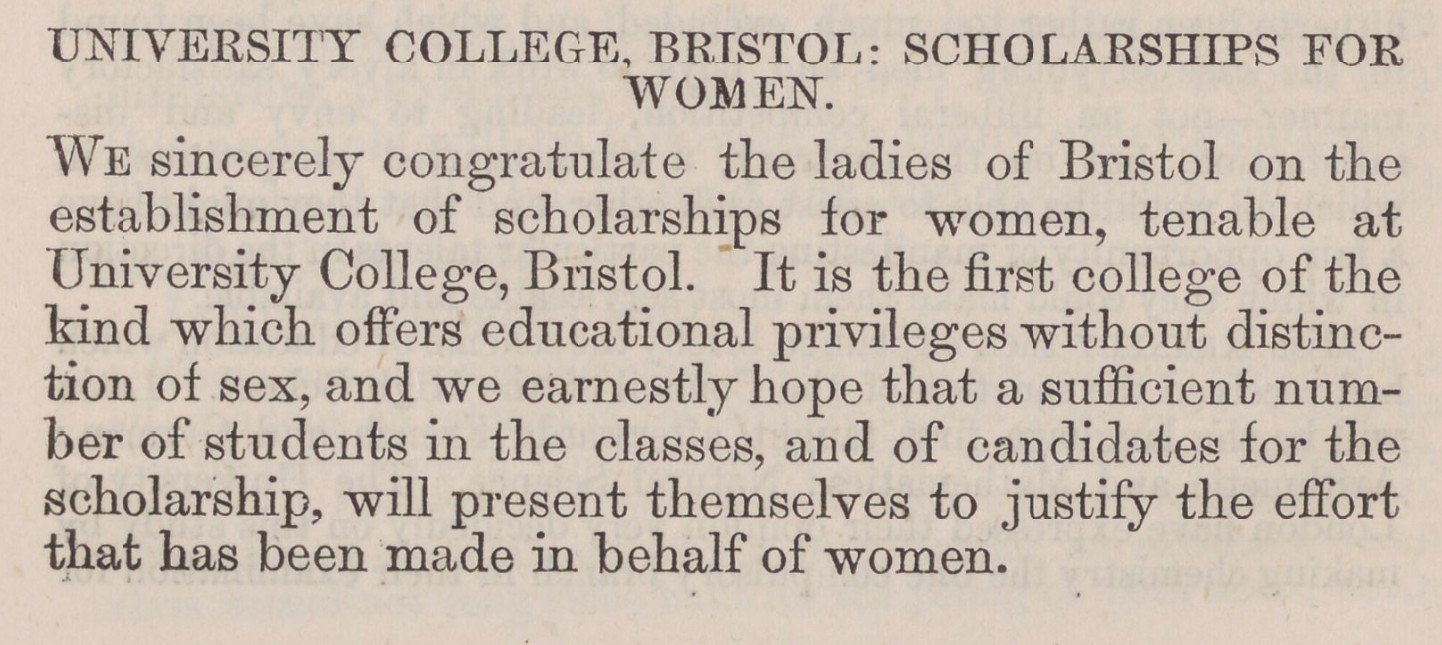
The Englishwoman’s Review, 15 September 1876, pp. 406. From The Social History Archive
The opening of the College was seen as a wonderful opportunity for women and there was much encouragement for them to sit the examinations at UCB in October. The fact that UCB had close ties with the Clifton Association meant that any attention given to the women’s scholarships would also be conferred on UCB.
The Association was a valuable asset to the College when it was just starting out, as it brought a considerable number of women to UCB’s first session. It provided substance to UCB establishing itself as ‘the first college of the kind which offers educational privileges without distinction of sex’. Fees paid by female students contributed significantly to the coffers of the new institution, while six of the first eight scholarships granted by UCB were earmarked for women. Indeed, such was the preponderance of women at the outset that some contemporaries wondered, slightly caustically, whether 'Bristol has not opened a new college for women'.[7]
UCB held the Association in high esteem at the outset. In a minute book from the 5th of October 1876 it was resolved that the honorary secretaries of the Clifton Association for the Higher Education of Women ‘be at liberty to attend the lecture rooms and the ladies' classes whenever they found it convenient’.[8] This kind of gesture is unusual and stands out from the matters usually addressed in the minutes – typically the appointment of Professors, the pledges of large donors and the acquisition of new land for buildings.
In 1878, Catherine Winkworth, Secretary to the Clifton Association and an active participant in the Liberal community of Bristol, died. In 1879, her peers brought an offer to UCB's Council.
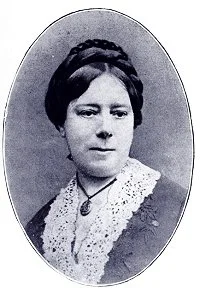
Catherine Winkworth, 1827-1878. Founding member and Secretary of the Clifton Association for the Promotion of the Higher Education of Women and translator of Lutheran hymns and poems from German
The committee in charge of arranging Winkworth's memorialisation at Bristol Cathedral still had a large sum of money left in her Memorial Fund after commissioning her commemorative tablet. They wanted to transfer this and the money in Clifton Association’s Scholarship Fund to endow a permanent scholarship in her name.[9] In the case that UCB should cease to exist, provisions should be made for transferring the scholarship fund to another place of higher education. The College accepted, formally gave the committee of women ‘the best thanks’ and arranged for the transfer to be made.[10]
In total, the College received £800, investing the money in East India Railway Company Annuities. The two annual winners of the Catherine Winkworth Scholarship would receive £15 each from the interest accrued on the investment. This was equivalent to what an unskilled labourer earned in six months – a sum that presumably reflected the assumption that the student would be living at home.
Twice in 1880, UCB drew on the capital provided from the Winkworth memorial fund to pay for new buildings. Expansion was direly needed, with the classrooms becoming crowded to the point of interfering with learning. The need for additional teaching space was regularly brought up, in part because of the fear that overcrowding would damage the new College's reputation. UCB would not have been able to proceed with this programme were it not for resources of the Catherine Winkworth Fund.
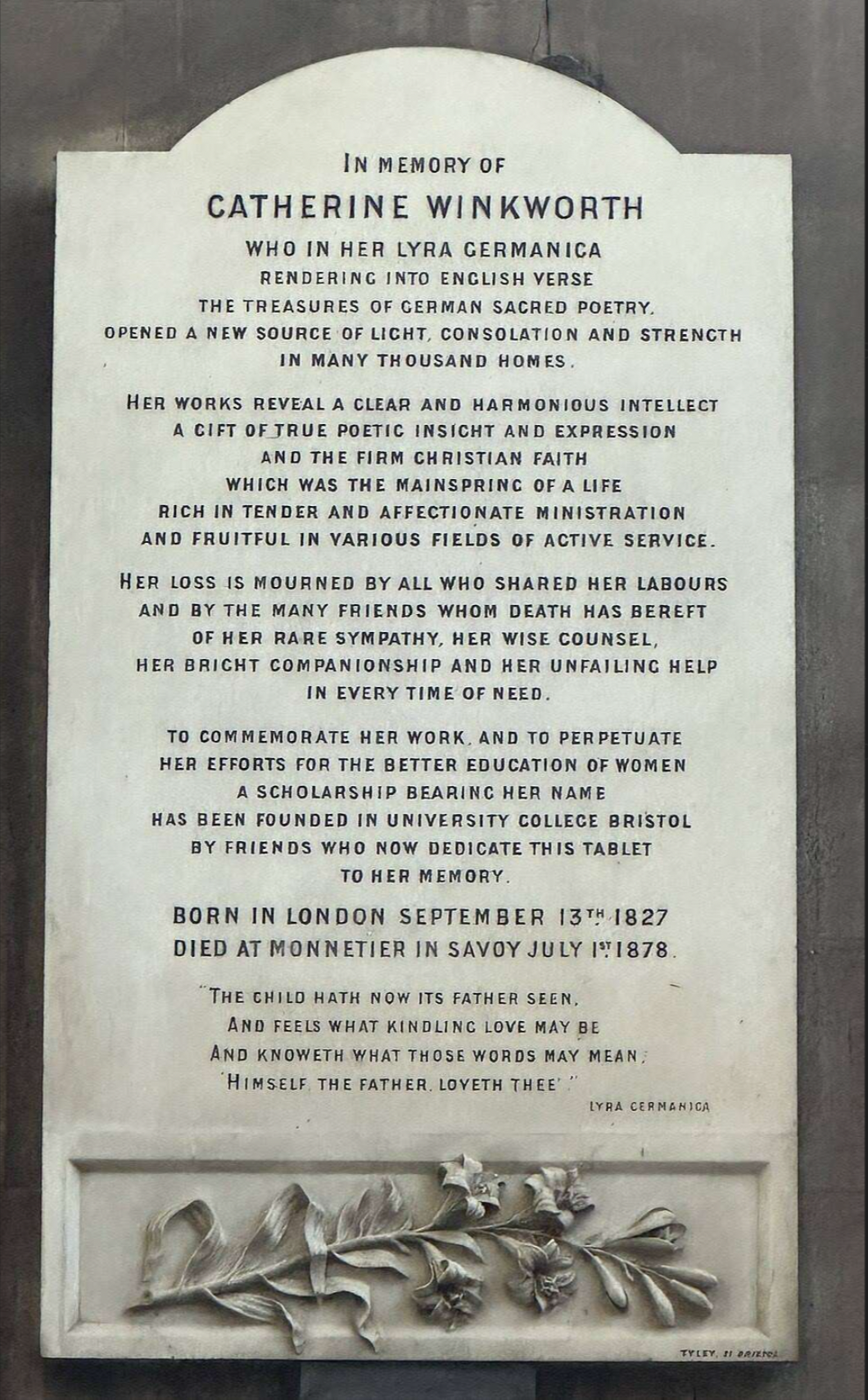
Winkworth's memorial tablet, Bristol Cathedral, 1878
In the years following its founding, UCB struggled to secure financial backing from Bristol’s citizens, the government, and organisations that had historically supported it. Caps on departments’ expenditure and on staff salaries were being introduced, the fees of evening classes were being raised and pleas for donations were becoming more frequent and desperate.
Bristol’s women saw the existential threats the College was facing and decided to raise funds to cover its operating costs and expansion. In May 1881 a Ladies’ Canvassing Committee was formed in Clifton to this end.[11] Their meetings were usually held at Goldney House, the residence of Miss Fry, who was the committee’s treasurer, and their efforts helped to keep UCB – an institution whose work they were invested in thanks to the vital role it played in their community and in advancing women’s interests – alive and running.
They brought forth new names of people to canvas, many of them women, that they could reach more easily through their networks than the committees of men could. They also used various means to raise awareness, like printing and advertising, all of which yielded impressive results.
In the Annual General Meeting that took place that year in November, the money raised by them, which equalled that of the earlier Winkworth Memorial Fund, was ‘gratefully acknowledge[d]’ by the Council.
The following year, their support was also mentioned as being crucial to the College being able to start work on a new wing. Thanks to their work in no small part, the figure previously promised was greatly surpassed. Over £6,000 was raised.
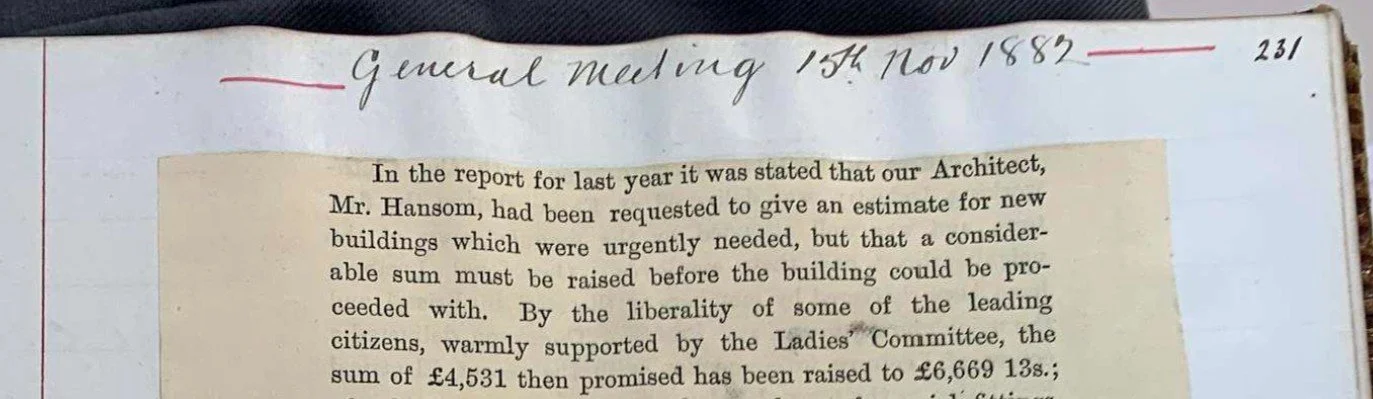
UCB General Meeting minutes, 15 November 1882, p. 231. DM506/57 in University of Bristol's Special Collections Archive.
The capital bestowed on UCB thanks to these women’s canvassing work had a decisive hand in shaping UCB’s fate – and did so for the better. Recognising the importance of women when we tell UCB’s early history sets the record straight.
This article has sought to put women back into the early history of UCB. This did not require radical revisionism: merely a recognition of contributions that the Victorian institution understood and appreciated at the time, but then somehow forgot. The endowed Catherine Winkworth scholarships were discontinued, while she and her associates are not remembered or commemorated by the University today, in any way.
While this might seem like a satisfying end to this story, there is one final point to make. Investigating 'Women and UCB', I became aware of one 'subaltern' group who have received little attention in any of the University's official histories to date: the students.
Most of the people at the University, at any one time, have always been students. And in the early days of UCB, almost half those students were women. At UCB there was an engaged and active community of women students whose experiences we can glean from sources of their own making, such as the Women’s Literary Society Minute Book in Special Collections.
Here we find their own descriptions and writings on their broad range of pursuits. Women would pick a topic to give a presentation on at every meeting, to provoke intellectual discussion. These included Shakespeare, The Domesday Book, the teaching of English literature in schools and philosophy too. They read plays together, and we can see the parts that members were allocated. Their works would go on to be fondly commemorated by students even over a quarter of a century after the society’s founding. The book is a reminder that, 'reading against the grain', it is possible to investigate student life. It is to such sources that we could turn if we want to escape the institutional bias of the self-regarding University, to capture the broader experience of women in higher education.
References:
[1] Introductory Page of UCB’s Calendar for the session 1877-8, found in the University of Bristol’s Special Collections. My thanks to Evan Jones, Rhys Mancell-Kent, Robert Bickers, Rachael Gardner, Ash Simmons-Hall and those who kindly gave their time to help me along the way.
[2] Such as Memorials of two sisters, Susannah and Catherine Winkworth, published in 1908 https://archive.org/details/memorialsoftwosi00shaerich/page/308/mode/2up?q=class or Life of Bishop Percival, by William Temple published in 1921 https://archive.org/details/lifeofpercival00tempuoft/page/n11/mode/2up .
[3] Memorials of two sisters: Susanna and Catherine Winkworth, p. 263.
[4] "Englishwoman's Review", 01 January 1873, p. 41. The Social History Archive. https://www.thesocialhistoryarchive.com/image-viewer?issue=BL%2F9900015%2F18730101&page=51&article=120&stringtohighlight=clifton+association+for+the+higher+education+of+women. Accessed 20 July 2026.
[5] https://archive.org/details/bristol-suffrage-report-1875/page/n1/mode/2up .
[6] Mentioned in "Englishwoman's Review", 15 September 1876, p.407. The Social History Archive. https://www.thesocialhistoryarchive.com/image-viewer?issue=BL%2F9900015%2F18760915&page=23. Accessed 20 July 2026 and also in Memorials of two sisters, p. 309.
[7] 10 October 1876. John Addington Symonds to his daughter Charlotte, in Charles Knighton, Bristol Records Society Vol. 71 Bristol University: Conception to Foundation, p. 50, https://archive.org/details/bristol-record-society-71/page/50/mode/2up
[8] Charles Knighton, Bristol Records Society Vol. 71 Bristol University: Conception to Foundation, p. 48, https://archive.org/details/bristol-record-society-71/page/48/mode/2up Rough Minute Book October 5th 1876, DM506/7 in Special Collections.
[9] Catherine Winkworth Scholarship Fund Minute Book, pp. 1-3, DM506/16 in Special Collections.
[10] Minute Book 1, pp. 129-130, DM506/57 in Special Collections.
[11] Canvassing Committee Minutes, p.28, DM506/19 in Special Collections.