By Martha Chapman, 3rd Year History
Content Warning: Game of Thrones Spoilers!
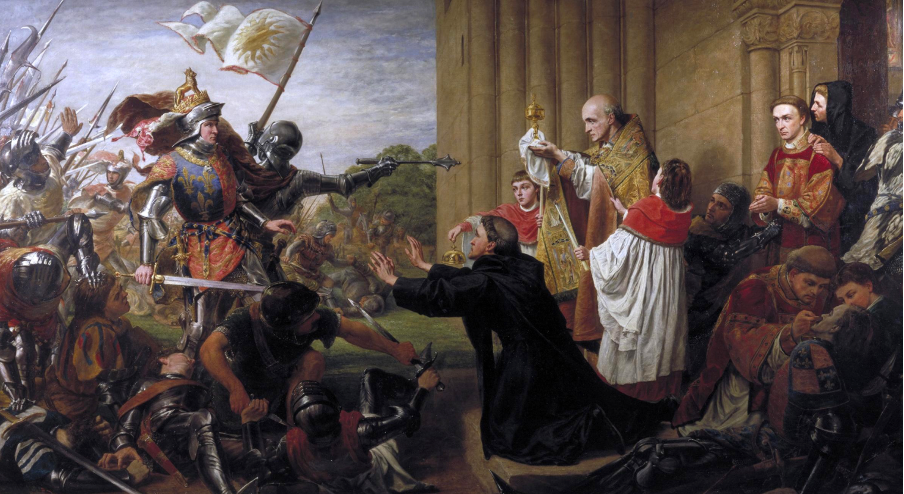
Edward IV of England and Lancastrian Fugitives at Tewkesbury Abbey
Epic fantasy series, ‘Game of Thrones’ (2011-2019) is centred around the bitter power struggles between noble families, all vying for control of the Seven Kingdoms of Westeros. Undead armies, dragons, extraordinarily bloody battles and thorny ideological conflicts captured audiences, becoming a cultural sensation.
However, its writer George R. R. Martin did not entirely invent this drama - English history had already done so for him. In the fifteenth century, England experienced its own brutal saga of rival houses, disputed heirs and political treachery. Martin has said that ‘Game of Thrones’ was inspired by his own medieval intrigue, where he drew on a range of historical sources, but his tale clings “closest” to England’s Wars of the Roses (1455 to 1485).
The story of HBO’s series should therefore be situated in its proper historical frame. The wars began with the death of King Edward III in 1377. This singular event sparked a series of conflicts that destabilised England’s constitution and greatly altered the dynastic and political landscape for over a century after. Edward’s oldest son, Edward of Woodstock, the Black Prince, died in 1376, before his father. Instead of the throne passing to one of Edward III’s four other sons, it went to his ten-year old grandson, Edward of Woodstock’s son, who became Richard II. Richard’s youth meant that the realm was ruled by minority government, a situation which bred disorder and factional conflict. In 1399 he was deposed, and this act of usurpation set the tone for the violent and turbulent decades that followed. Kingship, once considered sacred, was now reconfigured as something that could be challenged if the man sitting upon the throne was deemed to be unfit. In the years that followed, such judgements happened frequently, and zealous nobles repeatedly fought to claim royal power for themselves.
Powerful and ambitious individuals vying for control is at the heart of ‘Game of Thrones’, with the major houses, such as the Starks and the Lannisters feuding over the Iron Throne of Westeros. This discord was likely inspired by the civil conflict which occurred between the noble houses of York and Lancaster, where both families were descended from Edward III. Their dispute, like the feud between the Starks and Lannisters, arose from contentions surrounding legitimacy and the right to rule. They fought sporadically over the English crown for three decades until the ascendency of the Tudor dynasty.
‘Game of Thrones’ displays fifteenth-century influences in many of its characters, who distinctly resemble real historical figures from that period. For example, fan-favourite Tywin Lannister bears similarities to Richard Neville, the Earl of Warwick, popularly nicknamed ‘The Kingmaker’. Tywin is infamous for his adept political manoeuvrings and brutal success as a militant tactician, qualities he shares with the Earl. Warwick famously slew his own horse before a battle to ‘inspire’ his men, while Tywin orchestrated the infamous ‘Red Wedding’ in Season Three, a brutal event that secured his dominance in Westeros. Both men also used their children’s marriages to secure power. Tywin arranged the union of his daughter Cersei to King Robert Baratheon to ensure his grandchildren’s accession to the throne; Warwick wed his daughter Isabel to George, Duke of Clarence, the King’s brother in an attempt to obtain control of the crown.
The series’ most unpopular character is also found within English history. The arrogant, sadistic Joffrey Baratheon – one of the most hated characters on television – shocked viewers by ordering the execution of season one’s protagonist, the honourable Ned Stark, proclaiming, “So long as I am your King, treason shall never go unpunished! Ser Ilyn, bring me his head!". His character was loosely inspired by Edward of Westminster, son of the inept Lancastrian King Henry VI. At just eight years old, following the Second Battle of St. Albans, Edward allegedly told his mother, when asked how two captured Yorkist knights should be punished, “Let them have their heads taken off.” Contemporary observers, like John Fortescue, a Lancastrian Chancellor, described how Edward delighted in attacking his young companions with a sword and a lance. Fortescue’s treatise, Praise of the Laws of England, detailed how a king should operate and was written for Edward to curb the prince’s violence and instil a respect for the English legal system.
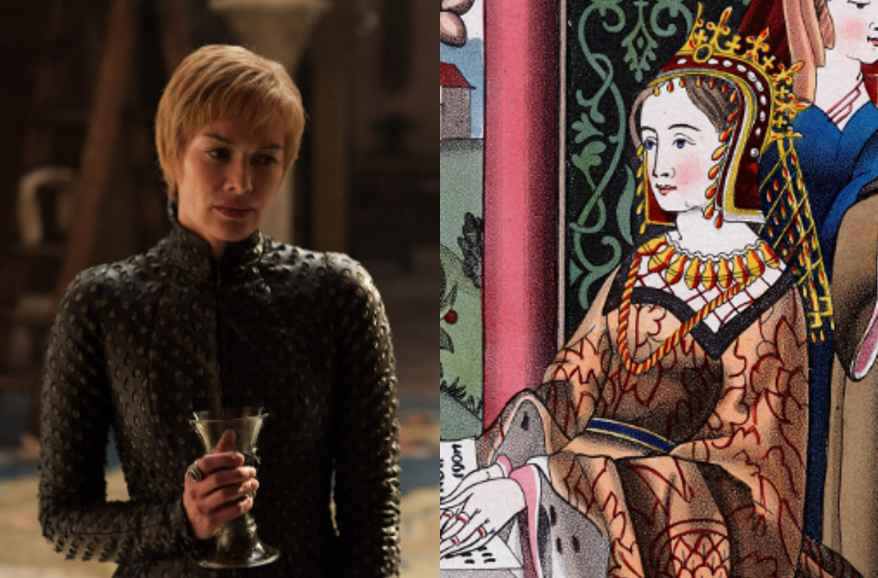
Lena Headey as Cersei Lannister in Game of Thrones, Painting of Margaret of Anjou
French-born queen Margaret of Anjou also has a ‘Game of Thrones’ counterpart. She was married to the mentally fragile King Henry VI, and as such she acted as the de facto head of the Lancastrian party, where she fought fiercely to defend her son’s claim to the throne. Margaret, the ‘she-wolf’ was viewed with hostility as she was seen to be disturbing the natural order of male-dominated governance. This ‘she-wolf’ persona is seen in ‘Game of Thrones’’ Cersei Lannister, a queen notorious for political scheming and vicious protection of her son’s claim to the throne. In both cases, political propaganda painted them as deviant, unnatural women, with Cersei forced to endure a ‘walk of shame’ naked and barefoot through the streets of King’s Landing. Margaret was also forced out of government; she was forced to return to France in 1475 and lived out the rest of her life in relative poverty.
‘Game of Thrones’’ epic bloody battles are so intense that it is difficult to conceive of them as resembling reality. However, these battles mirror the true brutality of fifteenth-century warfare. The Battle of Towton, which took place on the 29 March 1451 was the largest and most catastrophic battle ever fought on English soil, and saw one king, Henry VI be replaced by another, Edward IV. It is estimated that at least 28,000 men died while fighting at Towton. Some contemporaries believed the immense amount of blood spilled in this area is what caused the Towton Rose, the Rosa Spinosissima, a white flower, to develop red spots.
Perhaps the reason why ‘Game of Thrones’ was quite so popular is due it mirroring a real past which was every bit as savage and treacherous. The world of Westeros may be a fantasy realm of dragons and undead armies, but the plot is firmly rooted in England’s blood-soaked fifteenth-century.
Edited by Zoe Lambe