By Bea Vivian, 3rd Year English and History
A pervasive and institutionalised male supremacist complex existed in early medieval Iceland, shaped by its warrior society and the idolisation of warfare. The Icelandic Sagas (c. 1200 – 1300) offer a fascinating, often contradictory, portrait of women within this society. Carol J. Clover has argued that the sagas were composed by a population with a surplus of men, and their gendered imagination bears the stain of that imbalance. In many respects, Iceland was a frontier society, comparable to the nineteenth-century American West. Settlement attracted male migrants disproportionally, while female infanticide, practised chiefly through the exposure of newborn girls, thinned the female population from within. This is preserved in Icelandic genealogies: sons consistently outnumber daughters, and a number of men leave no recorded offspring, suggesting that they never married. The sagas’ near-formulaic narrative of institutionalised male violence mirrors a society dominated by men: outlawry, blood feuds, warfare, and raiding abroad form the focal point of the stories. The recurrent motif of the ‘love-triangle’ may also reflect the scarcity of women: typically, two men contend for a single bride. Differential male migration and female mortality thus point to an imbalanced sex ratio in Viking Age Iceland, and the saga’s recurrent motifs bear traces of that imbalance.
Such demographic context has prompted scholars to reconsider women’s place in medieval Iceland. If women were scarce, they may have held a degree of informal leverage within the household, even where the law gave them little formal power. The sagas thus speak of women with two voices. In one, the female heroine is proud and independent, acting as a ‘female inciter’ who goads her husband into feud, and on the other, she is given into marriage without her consent and constrained by the authority of her father or brother. Against this background, most scholars doubt that the shield-maiden, now so familiar from popular culture, was a historical figure. She is read instead as a literary construct of the male imagination, although, as Carol J. Clover argues, such figures may reflect a social reality in which daughters assumed the role of surrogate sons when the male line failed.
The sagas must be read in light of the circumstances of their recording. Transmitted orally for generations, they detail events of the 9th-11th centuries and were committed to writing only after Iceland’s conversion to Christianity, by authors who were almost certainly male clerics. This context conditioned the representation of women in several respects, notably their connection to pagan ritual and magic (seiðr). At the same time, the Church’s insistence on monogamy and its tighter regulation of divorce curtailed any latitude that pre-Christian custom had afforded women.
Nevertheless, representations of women vary considerably across the different subgenres of Old Norse literature. In the Íslendingasögur, or family sagas, women inhabit a recognisable social world, one that may preserve aspects of the experiences of historical women. In the legendary sagas, they more frequently appear as warriors and supernatural figures. Meanwhile, the mythological Eddas by Snorri Sturluson, depict women as goddesses, giantesses, trolls, and valkyries. One figure crosses all three registers: the völva, or female seer. It is in the mythological material, however, that the relation between female power and the natural world is most fully imagined. Through an ecofeminist lens, these texts reveal a recurring association between femininity, wilderness, and forces that resist patriarchal control.
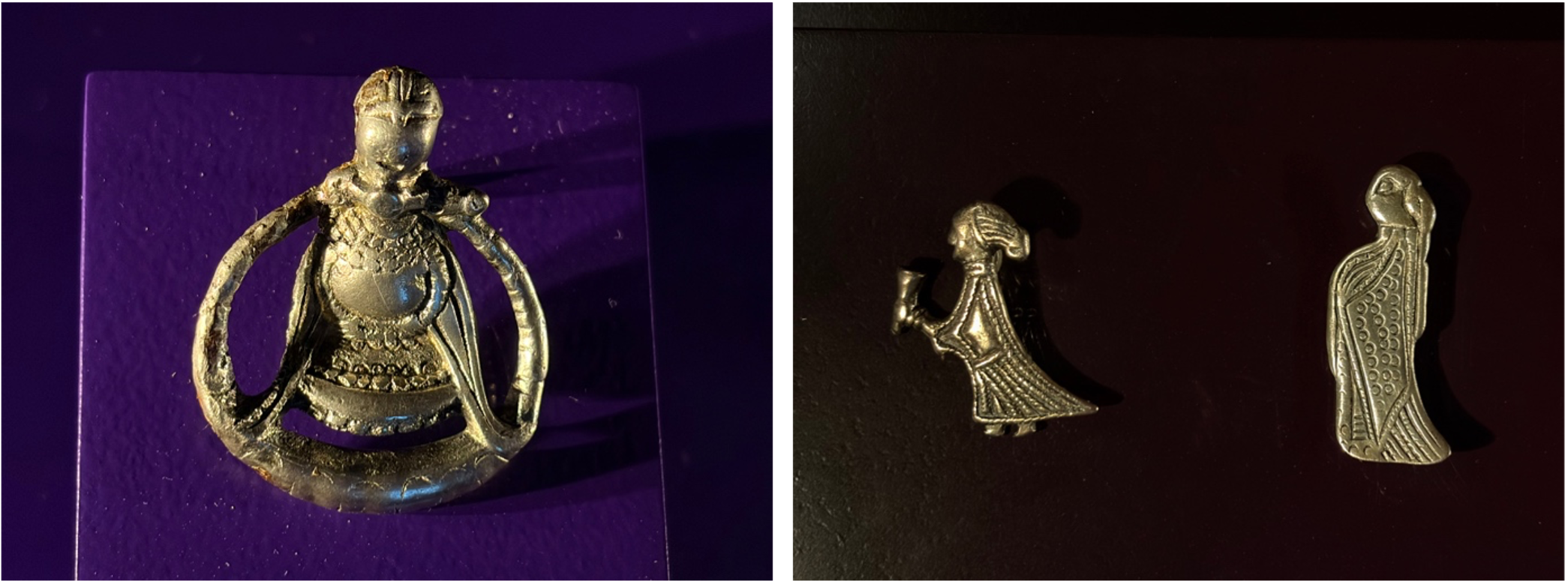
Figure 1. The Ash Pendant (left), potentially depicting the Norse goddess Freyja, pregnant. Discovered in a tenth century Swedish grave. Tenth century pendants depicting Valkyries (right) found on the Swedish island of Öland. Both housed in the Swedish History Museum.
The Norse creation myth presents the establishment of the gods’ world as an act of conquest over nature. The sky-gods construct the realms of Midgard and Asgard, enclosing them with protective fortifications to defend their society against the giants and the wilderness beyond. These forces beyond established order are frequently associated with the feminine. Troll-women, for example, embody a convergence of anxieties about female autonomy and the untameable natural world. The troll-woman stands outside the patriarchal structure of marriage and kingship; she is unmarried and yet has many children. She has unchecked sexual encounters, and the offspring that she produces are wicked, grotesque, and a threat to humanity. She is physically bigger and stronger than the male hero and so unsettles his authority, a significant danger in a warrior culture where status relied on physical prowess. She lives in wild places beyond the bounds of men: in mountainous caves, besides dark seas, or deep in misty forests. Snorri Sturluson’s Prose Edda (c. 1220), offers a striking example:
"A witch dwells in the east of Midgard, in the forest called Ironwood: in that wood dwell the troll-women, who are known as Ironwood-Women. The old witch bears many giants for sons, and all in the shape of wolves; and from this source are these wolves sprung. The saying runs thus: from this race shall come one that shall be mightiest of all, he that is named Moon-Hound; he shall be filled with the flesh of all those men that die, and he shall swallow the moon, and sprinkle with blood the heavens and all the air…"
The Ironwood-women represent a world beyond the boundaries of human society, where female reproductive power threatens the entire cosmic order. The wilderness functions as a symbolic space in which the structures of patriarchal society are vulnerable. There may also be a historical dimension to these depictions. Native to the landscapes of Iceland and Continental Scandinavia, troll-women frequently inhabit the North. Their strange dress and customs have led some scholars to read troll encounters as echoes of contact between Norse speakers and the indigenous Sámi people. The troll-woman may be understood as an indigenous woman reimagined through the perspective of settlers.
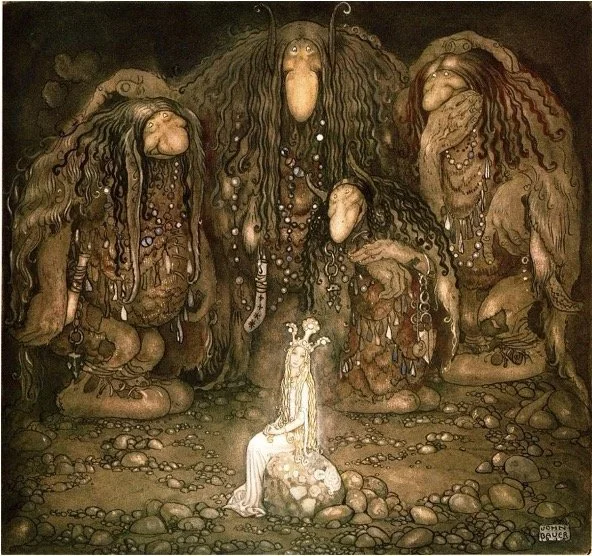
Figure 2. ‘“Look at them”, Troll Mother said…’ The famous caption from this 1915 watercolour illustration by Swedish painter and illustrator John Bauer.
Other female figures possess a different form of authority: the power to access knowledge beyond the reach of men. They are repeatedly associated with magic, prophecy, and fate. This connection is embodied most clearly by the Norns, three female figures who dwell at the foot of Yggdrasil, the World Tree, where they determine the destiny and lifespan of all living beings. This association extends to the practice of magic (seiðr). In the Ynglinga saga (c. 1225), Snorri traces seiðr back to the goddess Freyja, who ‘first taught the Asaland people the magic art.’ In the Poetic Edda (c. 1270), Óðinn awakens a dead völva to seek her wisdom about the gods’ fate. Taken together, these mythological texts suggest a recurring pattern: women are the keepers of fate and supernatural knowledge, which male figures must seek out. The same association appears in the historical sphere. Around 30 excavated graves in Scandinavia contain staffs or wands and have been interpreted as belonging to Norse seeresses. Determining biological sex is often complex, but almost all of these burials have been identified as belonging to women. The völva was not merely a mythological figure, but a respected profession practiced by female ritual specialists who performed magic and divination, often when hired to do so.
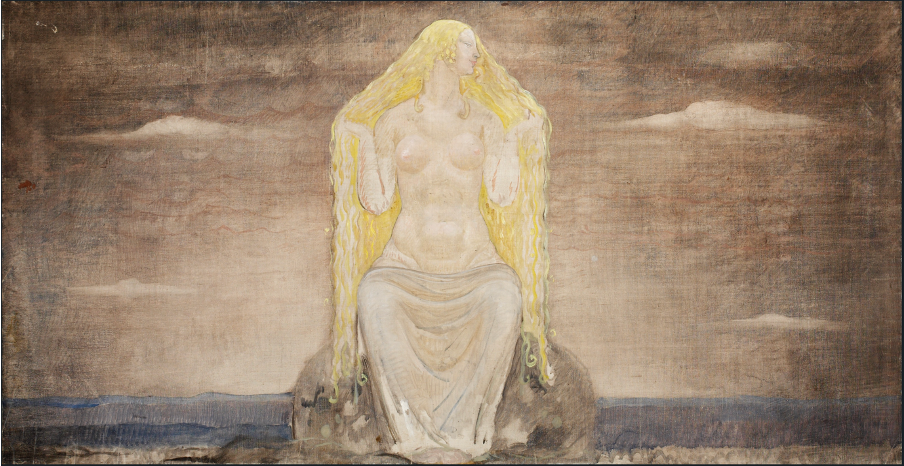
Figure 3. ‘Freyja’, 1905, oil on canvas, by John Bauer
At the very least, the sagas suggest that femininity, magic, and fate were closely connected in the Norse cultural imagination. Yet the clerical authors who recorded these traditions seem to have worked to simultaneously sideline and masculinise pagan magic. Not long afterwards Snorri names Freyja as the creator of seiðr, Óðinn, the All-Father, is written as its master and creator. They lowered the prestige of magic and increased the number of men in what had been a largely female profession, allowing Christian leaders to perform and benefit from it while the new faith established itself. When seiðr was conceptualised, it was done so in the shape of a man. These efforts are evident even centuries later: in the early modern Icelandic witch trials, 90% of the people accused of witchcraft were men.
The sagas offer a contradictory portrait of Norse women, shaped by a male-skewed population in frontier Iceland and by the Christian clerics who recorded them. Shield-maidens from the legendary sagas are most likely literary constructs, whilst troll-women embody patriarchal anxieties about female autonomy and an untameable wilderness. Women’s link to fate and seiðr runs the deepest, from the mythological Norns and the goddess Freyja, to the historical völva, attested in both literature and archaeology. Male clerical authors sidelined and masculinised this power. Femininity in the Norse imagination was therefore both feared and indispensable: a source of knowledge that men needed but sought to control.
Edited by Ariella Zimmerman
Further readings:
https://www.jstor.org/stable/27709600
https://www-jstor-org.bris.idm.oclc.org/stable/40918942?seq=1