By Bea Vivian, 3rd Year, English and History
Ethnonationalist groups often promote the false historical narrative that England was exclusively white until modern times, using this myth to push for anti-immigration policies or forced deportations. In media, diversity casting in historical fiction or fantasy television faces a lot of backlash, with critics arguing that ‘tick-box’ casting is historically inaccurate and has led to ‘blackwashing’, or ‘over-black representation’ on our screens.
Perhaps the most recent example is the casting of Lupita Nyong'o, a Kenyan, Mexican, and American actress, as Helen of Troy in Christopher Nolan's 2026 adaptation of The Odyssey. Elon Musk took to X to criticise Nolan's casting choice, stating that the director had 'lost his integrity', and that it would be an ‘insult’ to Homer to cast a Black women to play a fictional character described as ‘fair skinned, blonde, and the “the face that launched a thousand ships”’.
Diversity in British media is more than representation; it is truth-telling. This article aims to explore the long legacy of African presence and settlement in England. Heavily inspired by Miranda Kaufmann’s 2017 novel Black Tudors: The Untold Story, this article sets out to explore the lives of three free Africans who lived and worked in Tudor England (1485 – 1603), notably a period without an established slave trade.
Historians can trace the lives of over 200 Black people in Tudor England, a number that had expanded to 15,000 at the end of the 18th century. Unfortunately this research remains relatively new and requires extensive archival exploration. Kaufmann stated that when she began her research on Africans within Tudor Britain, the archivist at the National Archive claimed, ‘you won’t find anything about that here’. After a lot of digging, Kaufmann was able to discover networks and spaces in which free African people lived and worked.
The Westminster Tournament Roll is a painted manuscript that measures nearly 60 feet long, created in 1511 to celebrate the jousts hosted by Henry VIII. On the manuscript roll remains the only identifiable image of a Black Tudor, Henry VIII’s trumpeter John Blanke. John was a trumpeter in the King’s court from 1507 – 1512, after which his name disappears from records. Historians have determined that he arrived with Katherine of Aragon’s retinue from Spain in 1501.
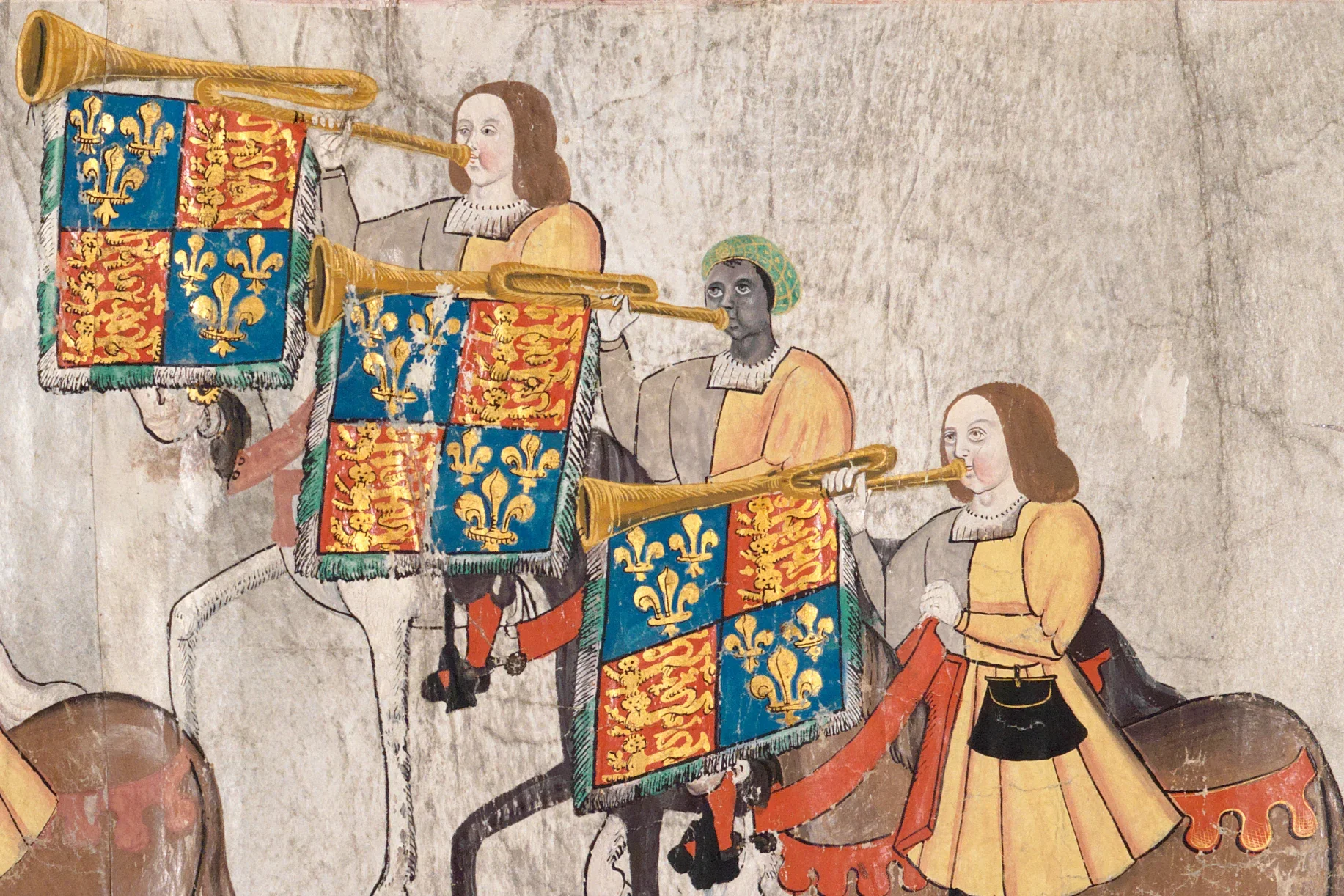
Figure 1. College of Arms MS Westminster Tournament Roll, 1511, Reproduced by permission of the Kings, Heralds and Pursuivants of Arms. © The College of Arms.
John was born in North or West Africa, or in Southern Europe to African parents. He is recorded as receiving 8d of pay per day, and on Henry VIII’s coronation in June 1509 he received four yards of scarlet cloth for a ceremonial gown. On 14 April 1512, the King himself gifted John a wedding gift, a fine outfit for the ceremony valued at nine pounds, including yards of violet cloth, black velvet, and a pair of scarlet hose. What is perhaps most interesting in the archives, is John’s hand-written petition to the king for a wage increase. John’s petition offers a glimpse into his agency within the royal household, revealing an individual who actively sought to negotiate the terms of his employment.
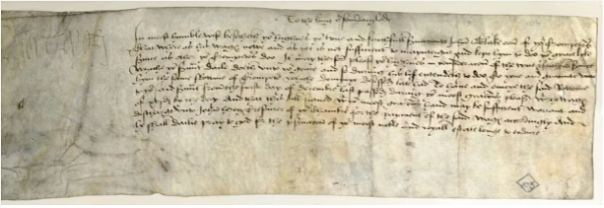
Figure 2. John Blanke’s petition for a pay rise, around 1512. The National Archive, CR: E 101/417/2. It reads: 'It may therefore please your highness in consideration of the true & faithful service which your servant daily doeth unto your Grace and so during his life intendeth to do, to give and grant unto him the same room [position] of Trumpet which Dominic deceased late had….'
Jacques Francis was a salvage diver and the very first known African to give testimony before an English court. After the Mary Rose sank in the summer of 1545, Jacques’ employer, a Venetian named Piero Corsi, was hired for a salvage operation. The lost guns on the Mary Rose were estimated to be worth around £2 million today. A team of eight men, including Jacques, were sent down to bring up as much weaponry as possible. After the successful operation, Corsi was paid nearly £560. He was accused of theft in 1548, and Jacques testified in court to adamantly defend his employer. Jacques was around eighteen years old and based in Southampton, an area in which there were ten recorded African residents between 1594 and 1611. In his testimony, he stated that he had been born on the island of Guinea, most likely the island of Arguin.
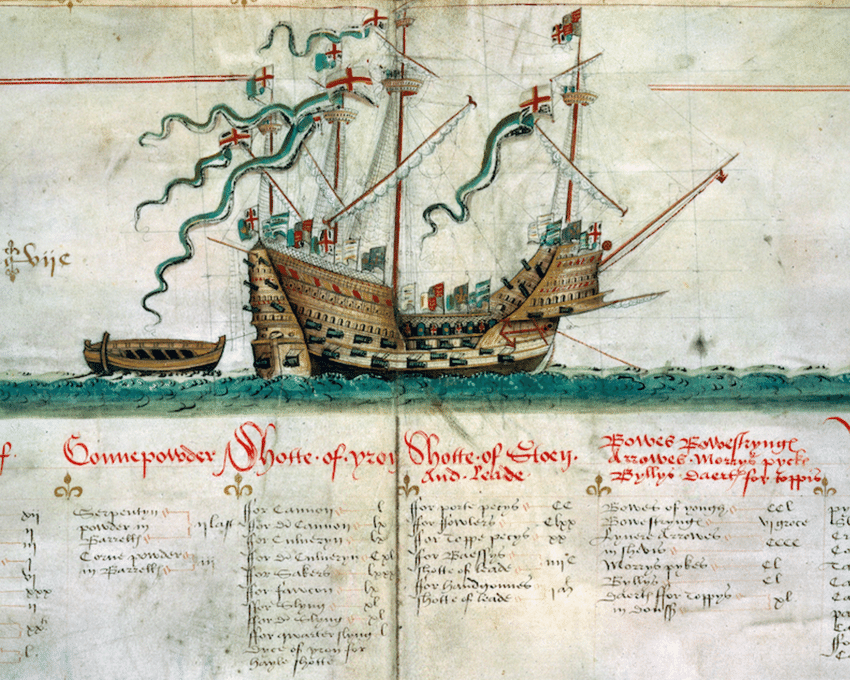
Figure 3: The Mary Rose depicted on the Anthony Roll (1546), an illustrated inventory of King Henry VIII's navy (by permission of the Pepys Library, Magdalene College, Cambridge, UK).
Jacques skill’s would’ve been valued highly, as most Renaissance Europeans were unable to swim, let alone dive. Africans from the Gold Coast region were described by Robert Baker in 1568 as ‘the most expert swimmers in the world’. It has been estimated that Africans made up half of the total diving and seafaring population in the Persian Gulf’s pearling industry. Jacques himself may have been a pearl-diver. He was a strong enough diver that in his testimony he described staying underwater long enough to ‘handle and see…[objects from the ship] being there perished and forsaken’.
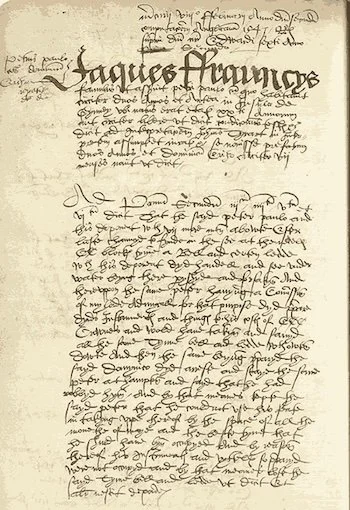
Figure 4. Jacques Francis’ testimony from the African American Registry.
Reasonable Blackman was a self-employed silk-weaver from Elizabethan Southwark. Kaufmann argues that his name might be a trading name, to market his reasonable prices of silk. Indeed, silk was expensive and was reserved for the wealthy; a 1533 edict forbade the wearing of taffeta, satin, or silk unless you had an income of over £100 a year. It was a new industry in London, and Reasonable most likely learnt his trade in a master silk weaver’s household. Reasonable had at least three children, suggesting that he had enough income to marry and support a family of five. Unfortunately, two of his children died young from the plague in 1592. He was not the only self-employed African artisan working in Tudor London. Kaufmann describes a Black man thirty years earlier who ‘made fine Spanish needles but would never teach his art to any’.
Unfortunately, there are limited records of named Black women from this period. Anne Cobbie was an African prostitute who lived in Westminster in the 1620s. Cattelena of Almondsbury (d. 1625), was an independent single woman who lived seven miles north of Bristol. An inventory of goods she owned after her death reveals that she owned a cow, an expensive possession.
This article has explored the lives of free African men who were skilled workers, musicians, self-employed artisans, husbands, fathers, and employees of the royal household. All of them lived in Tudor England. Black people were a part of English history long before modern immigration, challenging the far-right’s fantasy that Britain was white up until recently. Historical accuracy and diversity are not mutually exclusive; we need more complex and multiracial stories on our screens that celebrate the people who have long been part of Britain’s history.
References and Further Reading:
Miranda Kaufmann, Black Tudors: The Untold Story (Oneworld Publications, 2017)
The John Blanke Project: https://www.johnblanke.com/
https://www.hrp.org.uk/tower-of-london/history-and-stories/john-blanke/
https://www.nationalarchives.gov.uk/explore-the-collection/stories/john-blanke/
https://www.npg.org.uk/collections/research/john-blanke-and-the-westminster-tournament-roll