By Kedric Morgan, 2nd Year Politics and International Relations
Earlier this year, whilst backpacking through the Gambia, my friend and I stumbled across a crocodile sanctuary. There aren’t very many tourist sites for broke students in the Gambia, and the prospect of walking around crocodiles all afternoon was very enticing. Kachikally, the crocodile sanctuary, far surpassed our expectations. What we thought was going to be a fun excursion turned into not only a deep dive into the cultural and political history of the Gambia, but also into the role of Gambian troops in the Second World War, as part of what is frequently termed the Forgotten Army. This article gives an overview of the role West African forces played in the Burma campaign, a story few people know, and of their treatment by the largely white British officer class.
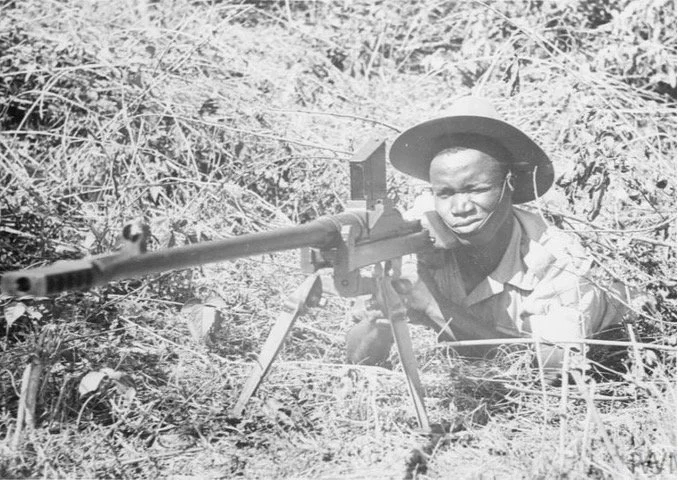
Figure 1: Sgt. Peter Levy behind an anti-tank rifle in India, 1944. Image Credit: IWM (IND 2887)
The Fourteenth (XIV) Army was formed in 1943 in the aftermath of the Arakan campaign, which saw the British and Commonwealth forces try to retake part of western Burma lost to Japanese forces the previous year. According to the 1956 autobiography of Lieutenant-General William Slim, ‘Defeat into Victory’ (Slim first led the Fourteenth Army), the men started calling themselves the Forgotten Army ‘long before some newspaper correspondent seized on the phrase’ (pp. 181-182). The West African troops in the Fourteenth Army made up two divisions, the 81st (West Africa) Division (of the Gambian troops, most were in this division) and the 82nd (West Africa) Division, within a wider African force of some ninety thousand in Burma. These troops were the forgotten of the forgotten: they fought in some of the harshest conditions of the Second World War, and often had to fight the bigoted attitudes of those commanding them. Most of the surviving literature concerns the 81st Division, so this article will be focused on their operational role. The 11th (East Africa) Division also deserves acknowledgement: its troops were tasked with establishing a bridgehead across the Chindwin at Kalewa during what Slim called a ‘strenuous monsoon campaign’ (pp. 365, 403). Although they saw less combat than the 81st Division, their contribution was no less significant.
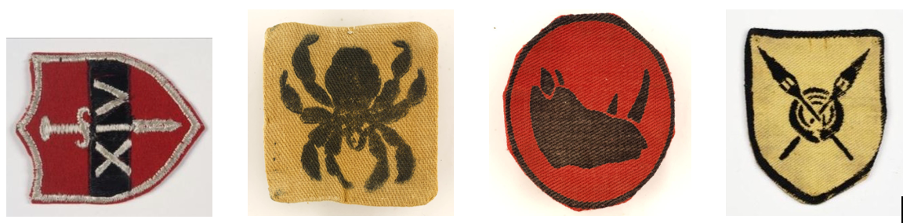
Figure 2: Formation badge(s) of the 14th Army (left), 11th (East Africa) Division (centre-left), 81st (West Africa) Division (centre-right) and 82nd (West Africa) Division (right). Image Credit(s): IWM (INS 5272), IWM (INS 4098), IWM (INS 4099), IWM (INS 7380)
The first African elements of the Fourteenth Army to arrive in Burma were the 81st Division, who were involved in the most combat out of any of the African divisions in Burma. They first served as a flank guard for the XV (Fifteenth) Indian Corps in late 1943 in the Kaladan Valley, with Slim later describing their Kaladan detachment as ‘hard-pressed and outnumbered’ (p. 241). The 81st Division was also the ‘first normal division to rely completely on air supply’ (p. 224), no mean feat when operating miles into harsh jungle. According to the historian and ex-officer (in the 81st Division) John Hamilton, in his 2001 account of the war ‘War Bush’, the division’s flexibility and ability to operate without continuous land support went unused: it was rarely deployed in scenarios where they could play to their strengths, and senior figures placed ‘little trust’ in it (p. 121). The 81st Division is also credited with building what came to be known as the ‘African Way’, a vital seventy-five-mile jeep track through difficult country (Slim, p. 224).
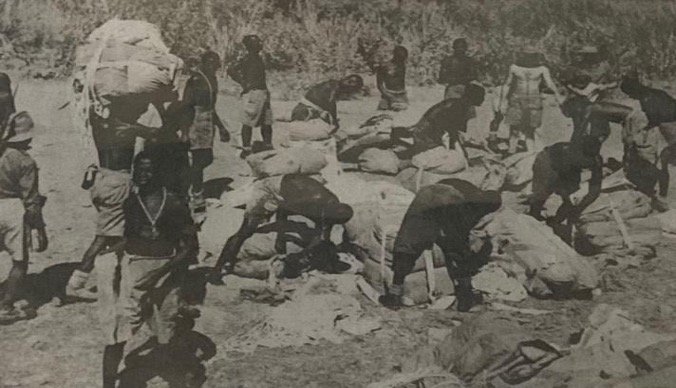
Figure 3: Soldiers from the 81st (West Africa) Division retrieving air-dropped supplies, 1944. Image Credit: Kachikally Crocodile Pool and Museum. Photo: Kedric Morgan
The reconnaissance regiment of the 81st Division is also credited by Slim for mastering the ‘technique of small amphibious commando operations' which led to the identification of the 'missing regiment of the Japanese 55th Division' which up until then was thought to be in the Pacific (p. 232). A more famous unit that fought in the Burma campaign was the ‘Chindits’ (also known as the Long Range Penetration Group), the brainchild of the controversial Major-General Orde Wingate, who specialised in guerrilla warfare operating behind enemy lines. As stated by Hamilton, the 3rd (West Africa) Brigade, part of the 81st Division, was seconded to Wingate to act as relief troops during Operation Thursday (p. 265), but eventually became garrison troops for the jungle ‘strongholds’ of White City, Aberdeen, and Broadway (p. 264). This was another instance where their distinct advantage of being ‘jungle mobile’, according to Hamilton, was passed over (p. 265). These ‘strongholds’ were used as bases for sabotaging Japanese support and communication lines. As stated by Hamilton, the 3rd Brigade received ‘very little coverage [on their role in Operation Thursday] compared with that given to the British and Gurkha columns of Special Forces’ (p. 261).
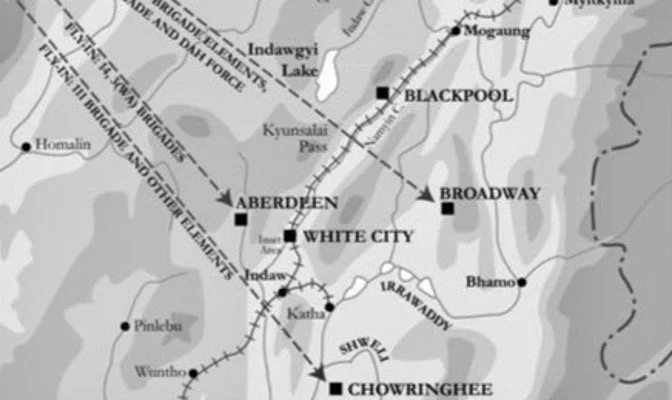
Figure 4: Graphic showing the ‘strongholds’ the 3rd Brigade were tasked with garrisoning. Image Credit: The Chindit Society
Veterans interviewed decades later described the distinct hierarchy and difference in treatment of the African troops compared to their European counterparts. Maimashi, a Nigerian veteran, stated that at the time they were treated like ‘[the British officers’] children’, whereas ‘in reality [they] were their slaves’. The entire Fourteenth Army was termed by Slim as ‘at the bottom of the priority list’ (p. 225), and according to Hamilton, the West Africans had to survive on the ‘very minimum of stores and reserves of ammunition’ (p. 30), something which Slim suggested would have made the Allied armies in Europe and North Africa ‘smile’ (the Fourteenth Army’s support was laughably thin by comparison) (p. 353). Although some volunteered to fight for the British out of a sense of loyalty to their colonial rulers, or for stability and a regular income, some veterans recall being forcibly recruited into it. In an interview with the Guardian, Gershon Fundi, a Kenyan veteran of the conflict whose account suggests similar practices elsewhere, recalls that if you ran from enlistment, the local chiefs would arrest you and bring you back to the British. After the war ended, in addition to being paid less than their European and Indian counterparts, many were not awarded the war bonuses promised, and recognition through medals or similar honours for long service was non-existent, according to Dangombe, a Nigerian veteran.
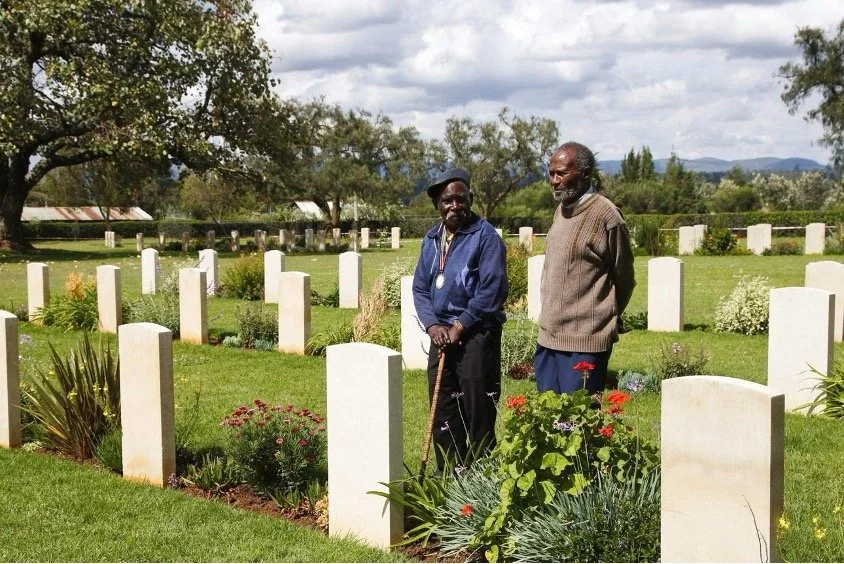
Figure 5: Eusebio Mbiuki (left) and Gershon Fundi (right), two veterans of the King’s African Rifles, paying their respects to fallen comrades at a war cemetery near Mount Kenya (2020). Image Credit: Jack Losh, The Guardian
As Hamilton argues, one feature of bush fighting is that ‘actions are often witnessed by a very small number’ (p. 344): it certainly doesn’t help that much of the literature on the Second World War is written by ex-British officers, who may have held prejudice against the African troops. Although Slim at times praises the African troops' efforts and is reported to have appealed on their behalf for access to their pensions (p. 224), he generally disparages the ‘sophistication’ and ability of the African troops under his command (p. 166; 185). He also omitted to mention them when thanking his forces at the end of the campaign. According to Hamilton, Lieutenant-General Oliver Leese had this to say about the feats of the 81st Division: ‘the battles of 81 (WA) Division […] were only little ones, fought in places whose names, even those displayed as their battle honours, mean nothing to those who were not there’ (p. 259). This reflects their lack of fame in popular history even today.
Hamilton notes that the African divisions often had no official observers (p. 142), with many of the renowned histories of the conflict underplaying the role played by African divisions either by choice or through lack of information. Because accounts like Slim’s and Hamilton’s were written by the men who commanded the African troops, they tell us a great deal about how officers saw their soldiers and much less about how the soldiers experienced the war. The veterans’ testimonies quoted here are therefore vital, but they are also a small sample, and this article cannot claim to represent the full range of African experiences. One of the hardest methodological challenges associated with this article has been accessing the papers and diaries of African soldiers who fought in Burma; Burma Boy (2008) is inspired by stories from Biyi Bandele’s father, and offers a fictionalised insight into the experience of some West African soldiers. Isaac Fadoyebo’s memoir A Stroke of Unbelievable Luck (1999) details his experience as a Nigerian medical orderly in the 81st Division and is a rare first-hand account, but it has long been hard to find. The Imperial War Museum holds further relevant sources, but many are difficult to access and not available online.
The sacrifice made by around fifteen thousand African troops who died fighting for the British in the Second World War still lives on in the surviving veterans, who were promised (as part of a wider package for Commonwealth troops) twelve million pounds of aid by the British government to support basic living requirements in 2018. According to Hamilton, captured Japanese prisoners told their interrogators that West African troops were the Allies’ ‘best fighters’ (p. 22): who better to judge their commitment than the men who faced them in hand-to-hand combat? The clear pride of the Gambian troops in the 81st Division on show at the museum is still resonant in my mind four months later, and is something I will forever associate with the Second World War.
Edited by Anna Luchmun, 3rd year History, sub-editor on Bristorian Editorial Team
To find out more about the Fourteenth Army and 81st (West Africa) Division, see:
William Slim - Defeat into Victory (Cassel and Co Ltd), 1956.
John Hamilton - War Bush: 81 (West African) Division in Burma, 1943-1945 (Michael Russel (Publishing)), 2001.
Biyi Bandele - Burma Boy (Vintage), 2008.
Isaac Fadoyebo - A Stroke of Unbelievable Luck (University of Wisconsin-Madison African Studies Program), 1999.