
By Benjamin Gbadamosi, 3rd Year History
Fela Kuti was an icon. He was a musician who fought against the oppressive and corrupt Nigerian state and the international neoliberal order of the late 20th century, using a strange brew of music, magic, and political criticism. He also founded his own country: the Kalakuta republic, located a few hundred meters from a military barracks in Lagos. Housed in a compound owned by his mother, it became a sanctuary for debauchery, progressive ideas, and the dispossessed. Although Kalakuta was a space for those with alternative views, for people who had been chewed up and spat out by a violent and oligarchic society, one thing was clear: Fela was the king. For breaking the rules, he issued fines, ordered people to clean the compound for days, and authorised beatings, including of women. The women who lived in his compound, whom he called his ‘Queens’ and whom he married in a single ceremony in 1978, all 27 of them, were free to sleep with whomever they wanted and have boyfriends outside the republic. However, they were never allowed to bring their boyfriends to Fela’s house - that was treason. Fela Kuti was an artivist, a visionary, a rebel. But in his republic, it is not difficult to make the argument that he was a patriarch who mistreated women. What impact should this have on his legacy? My answer is that we need to recognise this abuse, not ignore it, and protagonise the Queens in the story of the music which Fela made.
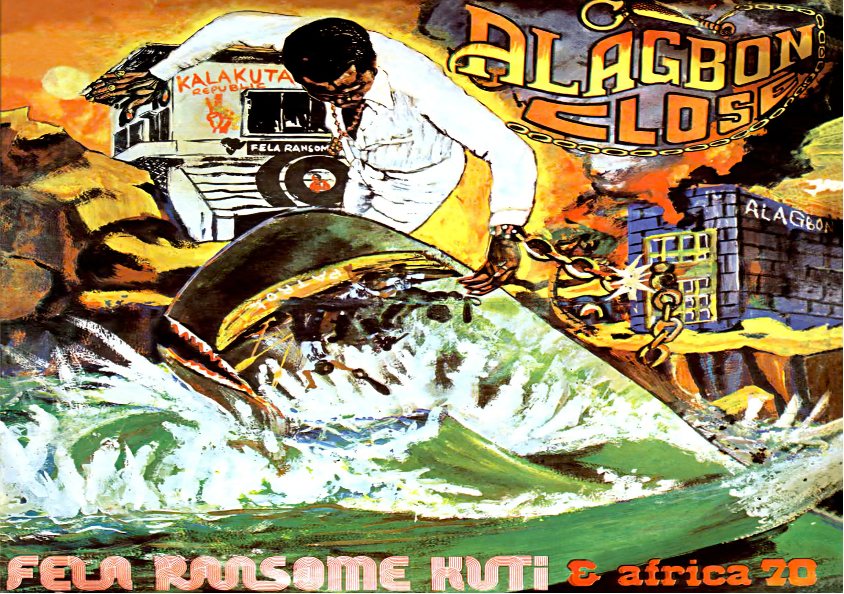
Figure 1. Cover art by Lemi Ghariokwu for the 1974 release Alagbon Close, published after a police raid on the Kalakuta Republic
THE KING
Ọba Waja is the phrase in the Yoruba language (spoken by an influential ethnic group in the country, to which Fela belonged) used to break the news that the King has died. It signifies a culturally significant moment. It means a reckoning: with tradition, succession, and the legacy of the previous monarch. Now that this musician, hailed as a kind of king, has been dead for 29 years, how might we reconsider his legacy? Is he to be remembered as the father of Afrobeat and an opponent of injustice, or, as the language of cancel culture might characterise him today, as a wife beater?
As people living in the present, we can shape the narratives told about the past, influencing how people, events, and movements are remembered. This is known as historical memory, and it is inherently malleable. In 2020, amid waves of anti-racist protests in Britain and internationally, the statue of the philanthropist and slaveowner Edward Colston was toppled in Bristol. Now, posterity will most likely remember him more for his involvement in the slave trade than for his philanthropic work, even though, before the iconoclasm, his legacy had at times been celebrated because of his good deeds. The case of Fela Kuti is, of course, very different. He was by no means a slave trader, so there is no need to metaphorically topple his statue. But he was flawed, and the evidence for his mistreatment of women and misogyny is substantial. We need not subtract from his legacy but rather add to it, by looking at how gender roles shaped his life and his actions, how he mistreated the Queens and most importantly, by recognising the central role women played in Fela’s life and work.
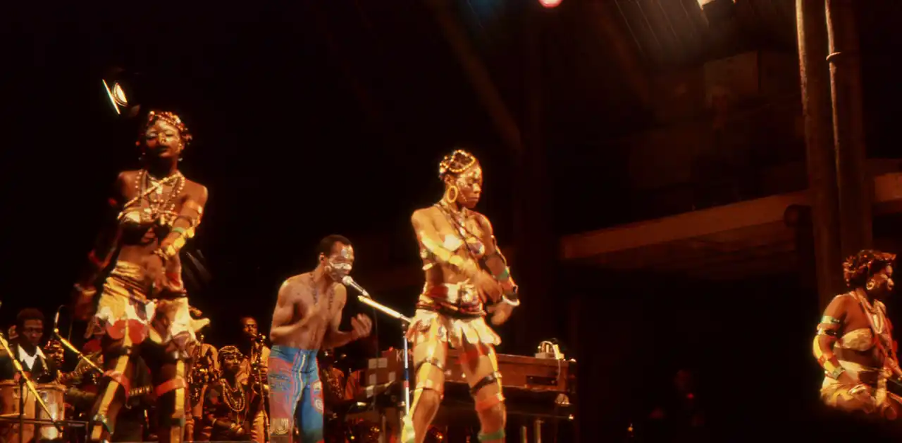
Figure 2. Fela Kuti and the queens performing at Glastonbury 1984, photo by Dave Walking
THE MUSIC
I propose taking a closer look at the gender dynamics in Fela’s life and music when considering how we remember him going forwards. Fela Kuti portrayed himself as raunchy, unapologetically African, and openly womanising. It was his partner, Sandra Isidore, an African American woman, who set him on the path towards embracing this version of African masculinity, introducing him to Black thinkers and radical politics. In response, Fela created an identity which was designed to cause outrage. In the chorus of his song Gentleman, he declares:
I no be gentleman at all o
I be Africa man original
Here, we can see that, in Fela’s mind, whether he sought to emulate European masculinity or embrace a more traditional form, he is a man, and that is non-negotiable. Fela’s masculinity was calculated to be rebellious and radical, against what mainstream Nigerian society at the time considered to be becoming and proper. His appearance during performances, with his face and body painted and his shirt off, was a flagrant rejection of Eurocentric norms and expectations of dress, which were deemed as more civilised and acceptable. Fela aimed to embody a positive affirmation of African culture and identity, particularly African masculinity. Yet, despite all he did to reaffirm and decolonise African masculine identity, his own conduct remained deeply patriarchal, and his views on gender traditional and pernicious. In his song Lady, a title which again mocks Eurocentric gender norms, he ridicules the Westernised African woman who considers herself equal to a man and rejects submission:
She go say him equal to man
She go say him get power like man
Here he contrasts these Westernised African ‘ladies’ with their notions of equity to the traditional African woman, who cooks for her man and does whatever he says. The song reflects the stiffness of Fela’s views on gender, an unfortunate contrast with the flexibility and rebelliousness of his critiques of colonial injustice.
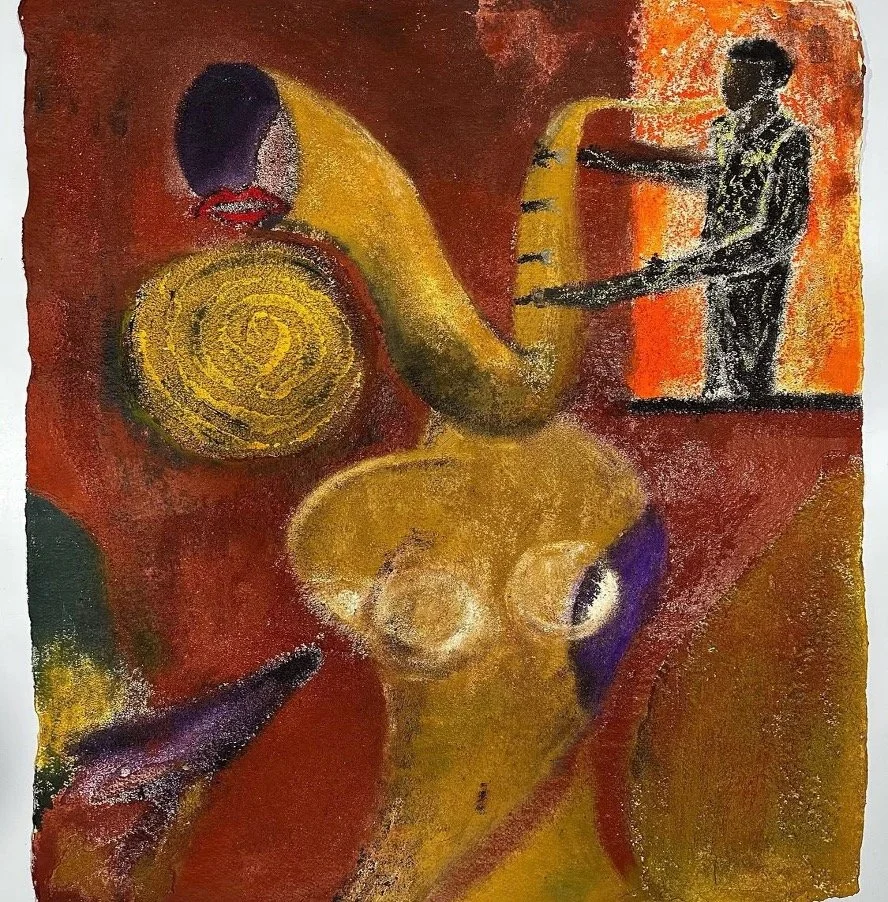
Figure 3. Painting by artist Kennedy Wilks, 2023, inspired by Kuti and titled ‘player’
THE QUEENS
A podcast series created by Jad Abumrad titled Fela Kuti: Fear No Man recently interviewed three of Fela’s Queens in Lagos. In the podcast episode they remembered him fondly but acknowledged the beatings (which were at least authorised by Fela) in the Kalakuta republic. They reflected that the interview was for them a rare moment: they had already begun to accept that they were forgotten. These women were an indispensable part of Fela’s sound; they provided a chorus of high and scratchy voices which contrasted ideally with his sonorous vocals, and they danced on stage with him. Musically, the significance of their contribution to Fela’s sound seems unequivocal, but they are consistently overlooked. Fela Kuti is widely recognised as the father of Afrobeat, a now world-beating genre. But Assistant Professor for Performance Studies at Northwestern University, Dotun Ayobade, gives us the hard truth: “without the Queens, there is no Afrobeat”. Afrobeat of course had a father, but it would never have been born were it not for the mothers.
Even without considering the centrality of the Queens to the music, Fela, when threatened by the army or the police, would make his female entourage crowd around him as a form of protection. They suffered beatings at the cost of protecting him, some even losing eyes. His own mother died after complications from violence she suffered at the hands of the army as they raided the Kalakuta republic, after being thrown from a window. Fela was inspired by and relied on these women, on his mother, on his partner Sandra for her intellectual guidance, and of course on the Queens. His music, in a way isn’t just his; it should be seen as a collaborative effort, shaped in large part by women. Chinyeri, one of the Queens interviewed for Fear No Man, put it most poignantly in what was perhaps the most affecting line of the episode:
“Thank you, for making it known to me that I am somebody."
And she is right. She is somebody. The Queens were essential to the work of Fela, suffering physical violence inside and outside of the Kalakuta republic, without their work being recognised. Fela’s treatment of women was at times unacceptable, but cancellation would be the wrong response. We would lose too much by turning our back on a man whose ideas remain relevant in a world still grappling with the consequences of colonialism. The best thing we can do in the present is, when talking about a man so often characterised as the sole author of a work which criticised an unfair world order, make space for the women without whom it would not have been possible.
Edited by Bea Vivian, Editor-in-Chief
Bibliography:
Guardian article on Fela https://www.theguardian.com/music/2010/oct/31/fela-kuti-musical-neil-spencer
https://open.spotify.com/track/7LAWgqlzE9bvjWQ6vql5Q2?si=288422f1ac7a4dda
Fela’s performace at Glastonbury in 1984 is an example of this https://www.youtube.com/watch?v=Ts9y5-nfoQ8&list=RDTs9y5-nfoQ8&start_radio=1&t=1708s
Fela Kuti: Fear No Man https://open.spotify.com/show/320MJFB99wFupBloqUoWJz?si=a7d2875cf6e541c7