From Sinterklaas to Ded Moroz: The Evolution of Father Christmas
By Charlotte Wyatt, 3rd Year English and History
Whether you picture the Father Christmas featured in those annual John Lewis adverts (which, let’s face it, always make us cry), or if you’re an avid reader of folklore tales and stories, the figure of a giant, jolly, fiercely red-cheeked man is in our minds at this time of year. But how did Father Christmas evolve into our present-day imaginings? What does the figure represent to people from different cultures across time? How did Father Christmas become the ‘Anglo-American’ Santa Claus and form the face of Coca-Cola? Well, whether you are reading this at Christmas time or in the hot days of July, it’s time to explore this iconic belly-laughing character we know so well.
Father Christmas’s origins actually start off with a real historical person: Nicholas, born in 270 AD and who later became the Bishop of Myra in modern-day Turkey. Though Nicholas became imprisoned by the pagan Emperor Diocletian, he was later freed by Constantine the Great and he continued his saintly work of giving charity, thus becoming St. Nicholas. He died in 343 AD, on 6th December, which is now known as St. Nicholas Day and in Christian interpretations, St. Nicholas became the figure of many stories and poetry with the association of gift-giving and charitable work.
However, it still wouldn’t be until much later that we see the figure of Father Christmas start to come to fruition. In medieval England, pagan Saxons honoured the ‘Frost’ or ‘Winter King’, which shared traces of the Norse god Odin, but came to be a dominant figure in Christianity, with Christmas day being associated with the birth of Jesus Christ. By the 1400s, he was known as the chivalric knight ‘Sir Christmas’ and heading into the Tudor period, he became ‘Captain Christmas’ (a great choice for the next avenger) whose superpower was to make sure everyone had fun at the lavish yuletide feasts, rather than giving gifts to children.
During the Interregnum period, Oliver Cromwell famously outlawed Christmas due to fears of unholy drunkenness and therefore sin. As a response, defenders of the tradition renamed the figure to ‘Old Father Christmas’ to make him sound more pious, which was maintained even after the restoration of the monarchy. Meanwhile, the Germanic origins of Father Christmas began with the figure of ‘Sinterklaas’, which was eventually adopted by Dutch settlers that brought the term over to the Americas. This would eventually lead to the evolved name from ‘Sinterklaas’ to the name now known best: ‘Santa Claus’.
Into the nineteenth century, Christmas itself experienced a revamp, as many books and poems written on the Christian character of ‘Old Father Christmas’ began to expand, marking a major turning point in how people interpreted Christmas and, therefore, what Father Christmas represents. Father Christmas formed the allegorical figure of kindness and hospitality in the face of social injustice and mass poverty, most popularised in a particular festive favourite of mine, Charles Dickens' A Christmas Carol. Father Christmas isn’t directly portrayed, yet the character of The Ghost of Christmas Present embodies Father Christmas, not just in looks but also in how he acts. There is something familiar about this character, a warm, larger-than-life character that shows Scrooge that togetherness and family are what Christmas is about, even for those like the Cratchit family, who have little to their name but their love for each other.
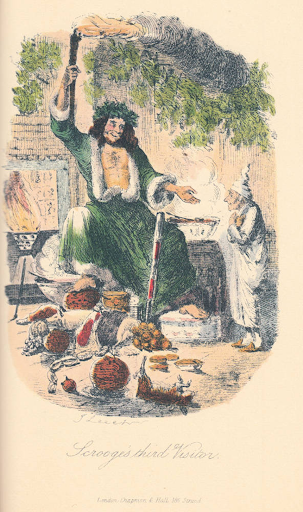
The Second of The Three Spirits or Scrooge’s third Visitor by John Leech from the original 1843 illustration of the novel. Image Credit: The Victorian Web.
In the novel, The Ghost of Christmas Present, comprises far more than an obvious pun on the word ‘present’. The ghost is described as having a ‘sparkling eye’, ‘joyful air’ and is surrounded by a feast as illustrated. The warmth and openness of the ghost initially comforts Scrooge, yet the ghost’s true role is to educate Scrooge - and the reader - that materialism isn’t what Christmas is about, but family, charity and kindness, offering Dickens’ perspective on how we ought to celebrate Christmas.
By 1931, the company Coca Cola needed an illustrator to create an image of Santa Claus for their advertisement to show that their drink could be enjoyed at any time of the year, not just on relaxing Sunday afternoons. They commissioned Haddon Sundblom (who also illustrated the Quaker logo for Quaker Oats), who drew inspiration from Clement Clark Moore’s 1822 poem, ‘A Visit from St. Nicholas’ - more commonly called ‘Twas the Night Before Christmas’. Moore’s creation of a warm, pleasant and plump human Santa in a red coat (yes, Santa did wear a red coat before the Coca Cola advert!) became the face of not just Coca Cola, but also Christmas itself. Sundlom’s paintings birthed the recognisable image of the ‘Anglo-American’ Santa Claus, who is still promoted holding and drinking Coca Cola in Christmas adverts to this day.
Despite the popularity of this marketing campaign, other images of Father Christmas are still widely celebrated. Ded Moroz is the Russian version of Father Christmas who is accompanied by his granddaughter, Snegurochka, rather than a sleigh and reindeers. Snegurochka’s name comes from ‘sneg’, the Russian word for snow, making her the Snow Maiden in Russian folklore, who delivers gifts to good children in celebration of the New Year. In fairy tales, it is told that the same Snow Maiden is the daughter of Spring and Winter, and melts after finding love. Although St. Nicholas is not directly connected to Snegurochka and Ded Moroz, there are remarkable similarities between his imagery and that found in Russian culture and art, leaving Russian folklore and storytelling clearly intertwined with globally popular cultural celebrations such as Christmas and New Year.
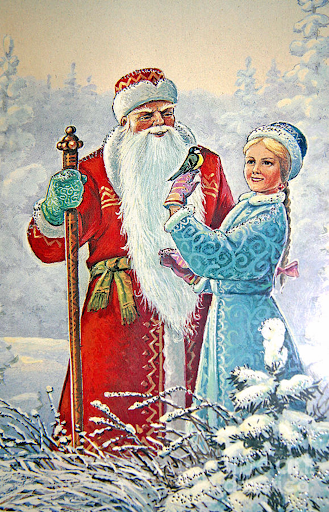
Ded Moroz and Snegurochka Art. Image Credit: Fine Art America.
Multiple incarnations of Father Christmas from cultures and traditions spanning over a thousand years have combined and evolved to form a modern conception of the figure. A generous, jovial, big-bellied, red-coated man, Father Christmas above all else maintains a festive spirit, giving to others and love of Christmas.
Edited by Scarlett Bantin