A Tax on Beards? Inside One Russian Tsar’s War on Traditionalism
By Archie McKinlay, 3rd Year History
“Death and Taxes” are often jokingly asserted to be the only two things promised to us in life. It’s no secret that taxes are unpopular, and that people often bemoan their hard-earned money seemingly disappearing to never be seen again. Income tax, inheritance tax, council tax, road tax, the list seems to never end. But for all the complaints about modern taxation, beards, at least, have never come into the debate. So how was this not always the case?
Tsar Peter I of Russia (r.1682-1721), commonly remembered as Peter the Great, felt differently about beards. Aged twenty-five, he conducted an incognito ‘Grand Embassy’ of Europe and was deeply inspired by the scientific progress of Enlightenment Europe. He viewed his own Russia as dangerously backwards, lagging behind Europe in a state of medieval traditionalism. Something was going to have to change.
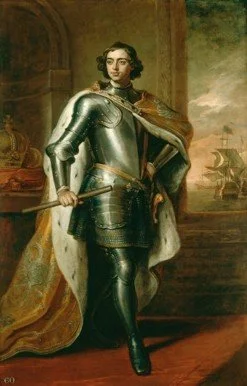
Figure 1: Tsar Peter the Great (1672-1725) posing for Sir Godfrey Kneller in London, 1698, during his Grand Embassy to Europe. The portrait was presented to King William III, portraying a distinctly modern (and decidedly clean-shaven, bar a moustache) Peter for Western consumption.
To turn Russia into a powerful modern nation that could be equal to the great states he visited, he introduced sweeping reforms. He fought long wars and annexed large amounts of the Baltic coastline, from which he built the city of St Petersburg, dubbed Russia’s ‘window to the West’, replacing Moscow as the capital of Russia in 1712. He founded the Russian Navy and set up the first standing army to fight these wars, taking much inspiration from European models. He curbed the power of the Russian Orthodox church by abolishing the patriarchate, promoted higher education and created a Governing Senate in 1717.
Perhaps the hardest part for Peter, however, was to reform Russian society. To Peter, Russians just didn’t look very civilised. And so Peter’s war on traditional Russia engaged a new battleground: men’s faces. The thick, long beards sported in Russian society were an instantly noticeable difference from the clean-shaven men of Europe. These men’s faces reflected modernity and science, and his own men’s reflected superstition and backwardness. If Russia was to be taken seriously – the beards would have to go.
The first stage of this transition was Peter’s most extreme. On his return from Europe, various accounts record Peter producing a large razor at a reception and shaving his guests' beards himself. That Russia was to be a beardless society was declared, and so the war on beards began.
Unfortunately for Peter, many in Russia didn’t feel as enthusiastic about a clean shave as he did. Many were unaware and uninterested in the proceedings in Europe and naturally didn’t feel the need to lose a familiar part of their own appearance. Furthermore, many in the highly influential Orthodox church attributed a spiritual significance to their beards, even considering a smooth face to be a sin. Beards were not going out without a fight, and Peter’s war was proving to be hairier than expected.
Peter was forced to tone down his assault. His ideological dream of a Russian society that was Western down to the follicles of hair (or lack thereof) on their men’s faces was checked by the practical realities of implementing a blanket ban on beards. And thus, a political climb down resulted in one of the strangest policies ever introduced in Russia: a beard tax. Those who were too deeply fond of their beards to let them go could pay for the right to keep them.
The amount required to keep your beard varied by social status, but the principle remained the same. Those who cared enough about their beards to pay a financial sum were permitted the right to keep them, but otherwise they had to go. Beards became a luxury, like choosing to buy a new jacket; you had to choose whether or not it was worth the cost.
Of course, whilst the beard tax solved problems, it raised others. Mainly, how was one to distinguish between a legal, taxed beard and an illegal beard? To answer this question, there was introduced another of history’s most absurd inventions: the beard token. Those who had paid for the right to keep their beards were issued an official beard token to be presented as proof of lawful facial hair if challenged.
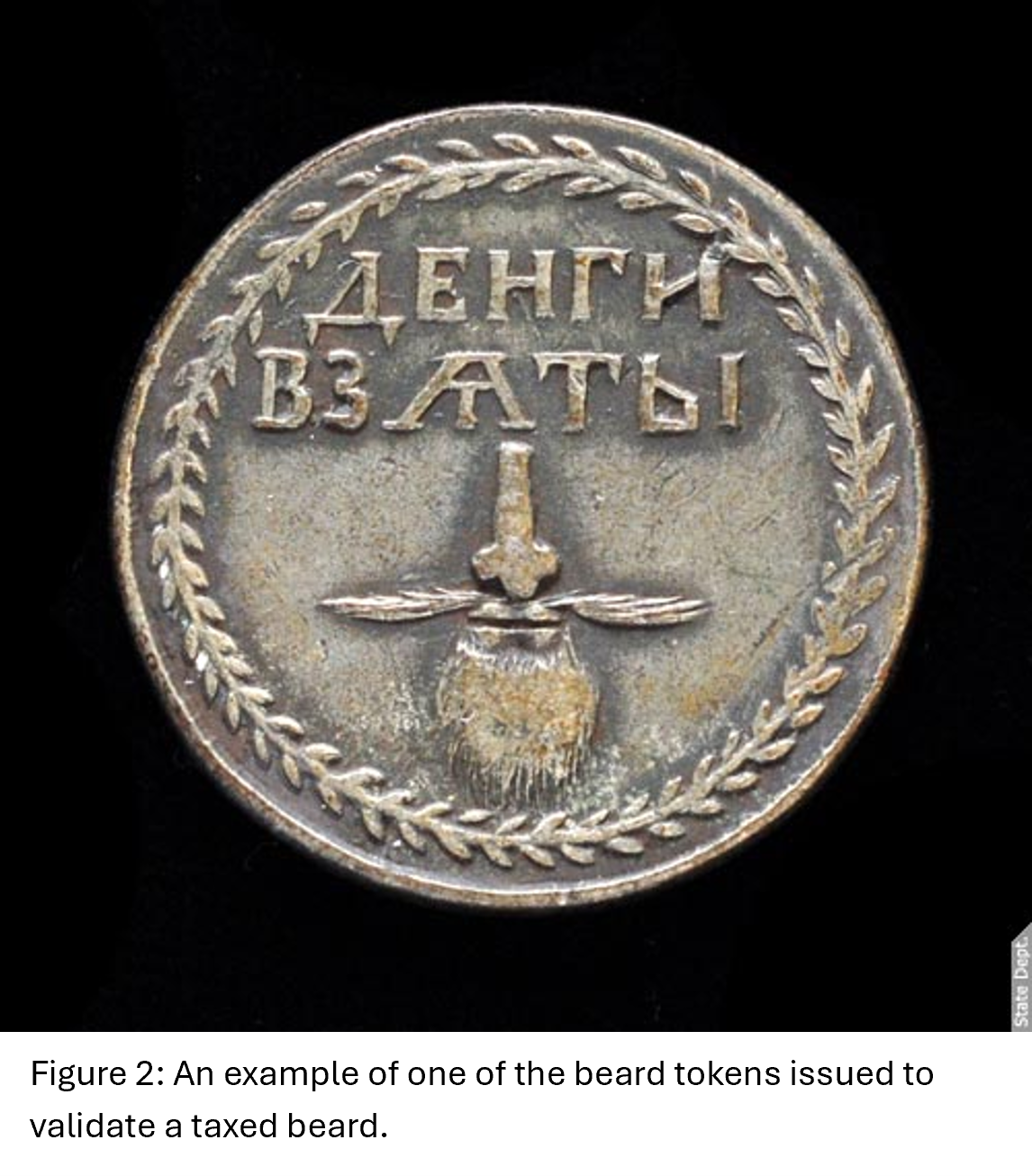
Figure 2: An example of one of the beard tokens issued to validate a taxed beard.
With that, Peter’s war on Russian faces was finalised, and the beard tax would continue more or less unchanged for seventy years. Whilst it may seem eccentric by modern standards, the tax is an excellent insight into how far Peter the Great was willing to use coercion, law and force to revolutionise Russian society. His willingness to bring the fight to something as deep-rooted as the beard reflects the extent to which he aimed to change Russia. When we talk of culture wars today, we ought to remember that the Imperial Russians did it best.
Further reading
‘Peter’s War on Facial Hair’, https://russianlife.com/magazine/january-february-2022/peters-war-on-facial-hair/
Walsh, Devan. ‘Analysis of Peter the Greats Social Reforms and the Justification of the Reactions from the General Public’, https://wou.edu/history/files/2015/08/Walsh-Devan.pdf
Mancini, Mark. ‘The Time Peter the Great Declared War on Facial Hair’, https://www.mentalfloss.com/history/time-peter-great-declared-war-facial-hair
Edited by Nadia Bishop-Broadhurst