
By Oliver Bell, 3rd Year History
Europe is often seen as enjoying a ‘long peace’ after WW2. This can be seen in a political consensus in favour of welfare capitalism, the EU’s emphasis on peaceful co-dependence, and American funds helping rebuild shattered economies. Obviously, this perspective overlooks the very different situation Soviet-dominated Eastern Europe faced, but it also overlooks the continuing presence of violent political action in Western Europe.
Especially in the 1960s and 1970s, terrorist groups challenged established orders through violence. Motivated by far-left, far-right, or separatist political causes, this brutality complicated the idea of a uniformly peaceful post-war Europe. This article will explore the most consequential of these groups, why they resorted to violence, and what they aimed to achieve.
Far-left Groups
The Red Brigades
Emerging from the heightened fervour of left-wing politics during the late 1960s, the Red Brigades were formed by students and radical activists in the enormous factories of Northern Italy. They believed Italy was at risk of a far-right coup, and that parts of the government were colluding to bring back fascism, despite post-war Italy’s constitution actively repudiating its fascist past.
The group traced its roots back to the anti-fascist/anti-nazi partisan groups of WW2, though hardly any of its members had actually taken part in the resistance. It also drew inspiration from the Uruguayan communist group the Tupamaros, who made use of violent tactics like kidnappings and murders.
The Red Brigades’ first actions were factory-based, such as petrol bombing bosses’ cars and destroying corporate property. As their proficiency grew, however, they expanded into kidnappings of hated floor managers and foremen. Their actions were designed to make a political statement, with pictures of beaten-up victims at the mercy of armed kidnappers sent to local newspapers.
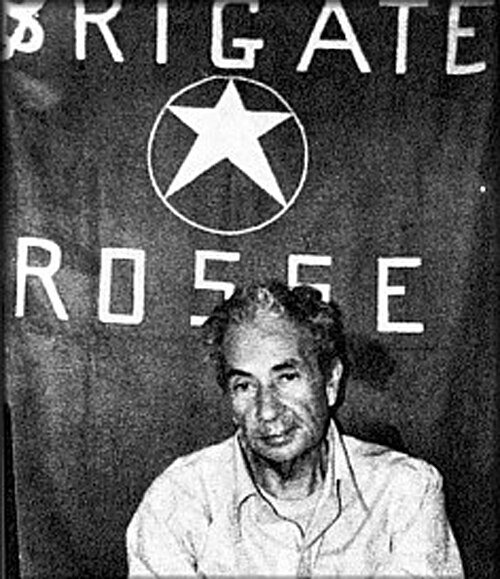
Figure 1: Photo of Italian politician Aldo Moro in front of a Red Brigades banner, taken by his kidnappers. Credit: Wikimedia Commons
The Brigades’ most notorious action was the kidnapping of former prime minister of Italy Aldo Moro. Taking place at the height of the group’s power, five men on 16th March 1978 blocked Moro’s convoy on his way to parliament, murdered his four bodyguards, and took the politician to a secretly constructed ‘people’s prison’. Moro was held for 55 days while his kidnappers demanded the release of several prisoners. When negotiations were refused, the kidnappers held an improvised trial for Moro, accusing him of being a counter-revolutionary for his role in the centre-left Christian Democratic Party. Moro was inevitably found guilty, bundled into a car, and shot, his body left in central Rome.
From 1970 to their dissolution in 1988, the Red Brigades claimed 80 lives and injured and kidnapped countless others. Though they had considerable support among factory workers, doctors, lawyers, and university professors, most Italians were united in their opposition to, and fear of, the Red Brigades. So infamous was their violence that many refused to serve on juries when Brigade members were on trial, for fear of retribution. The extent of their violence forced the Italian state to adopt a much harsher justice system, including longer sentences and even resorting to illegal torture.
Red Army Faction
Also originating in 1968, the Red Army Faction (RAF) was set up by Marxist-Leninist students in West Germany, fueled by their belief that post-war ‘denazification’ had not created a decisive enough break with their country’s past. They insisted that the West German state was still fascist and needed to be resisted through violent action. The group’s name sought to link them to the soviet bloc, and though there was no formal connection between the two, evidence has been uncovered that the East German secret police provided some members with support and shelter.
Beginning their career with the bombing of a department store and an American military base, the RAF were also motivated by the anti-imperialist and anti-capitalist movements of the 60s and 70s, particularly Maoism and the opposition to the Vietnam war. Infamously, they seized the West German embassy in Stockholm, resulting in the murder of two hostages before the terrorists surrendered.
Their activities culminated in the so-called ‘German Autumn’ of 1977, including the kidnapping of prominent businessman and ex-Nazi Hanns Martin Schleyer and involvement in the hijacking of a plane to force the authorities to release prisoners. After the failure of this scheme, Schleyer was killed, and those RAF members in prison committed suicide, in a development that has given rise to numerous conspiracy theories.
The RAF formally disbanded in 1998, likely due to the loss of support from (now reunified) East Germany, the imprisonment or death of many of its members, and a wider decline in political radicalisation.
Far-right groups
Italian neo-fascism
As mentioned, post-war Italy rejected fascism in its founding document, the Constitution of 1948. However, there still existed parties that aimed to maintain fascist ideals in modern Italy, notably the Italian Social Movement (MSI), formed by ex-supporters of Mussolini. Their initially legal methods of achieving power allowed them to avoid proscription, but in the 1960s several splinter groups rejected democracy in favour of violent means.
The most famous action of a far-right terrorist group during this period was the Piazza Fontana bombing, in which a bomb was detonated in Milan’s National Agricultural Bank, killing 17. By far the most devastating attack, however, was the bombing of Bologna railway station in 1980, resulting in the death of 85 commuters and the injury of hundreds more.
These attacks were motivated by a so-called ‘strategy of tension’, a belief that violent terrorism would generate instability and fear, discrediting Italy’s democratic institutions and paving the way for an authoritarian takeover.
The explosion of politically motivated violence in Italy in the 1970s and 1980s was so pervasive that it characterised the whole period. ‘Years of Lead’ is the name given in Italy to describe this time of radicalisation and terrorism, which stemmed from an ideological opposition to Italy’s political system and institutions.
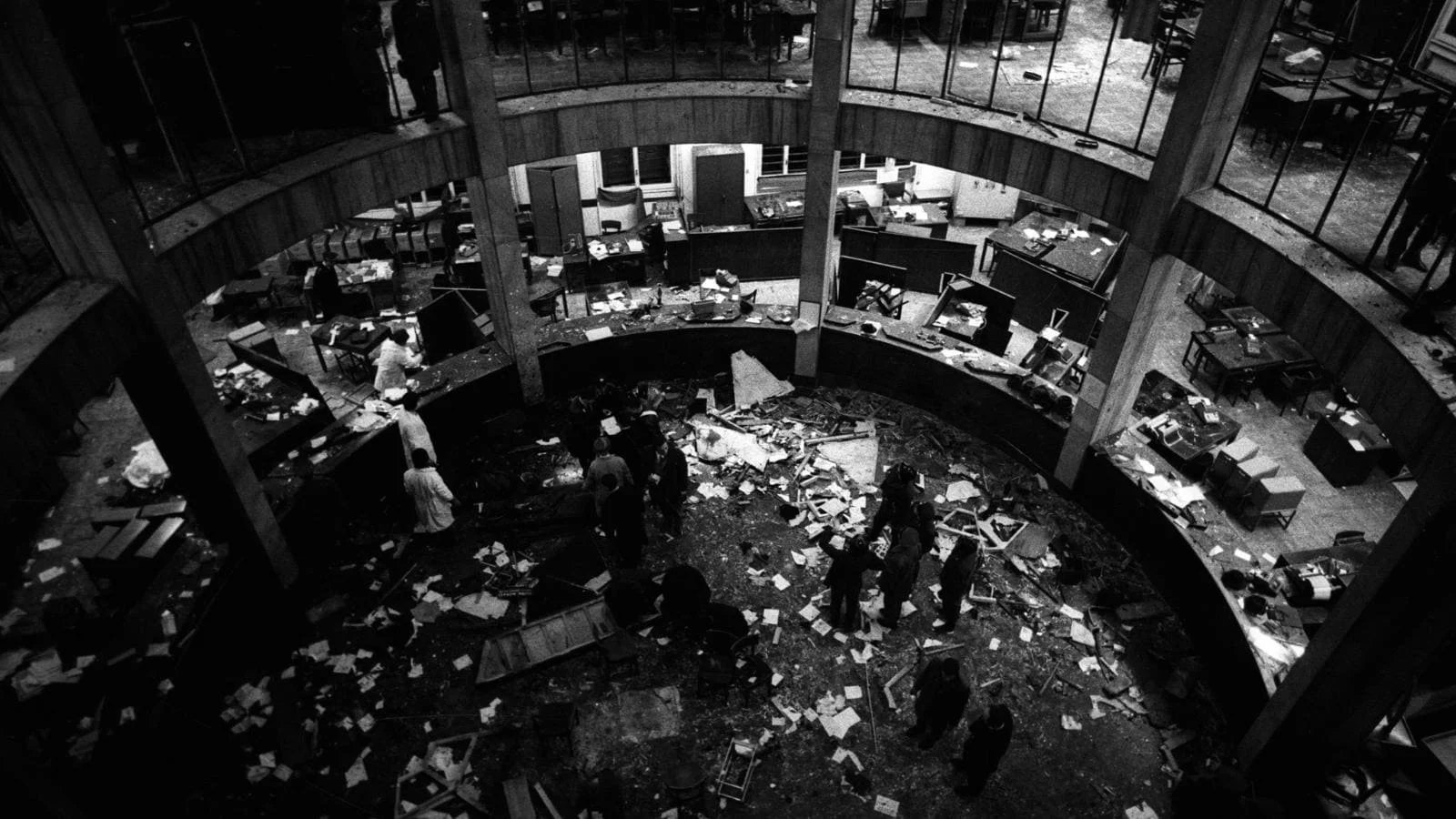
Figure 2: The destruction in Milan’s National Agricultural Bank after the far-right terrorist attack. Credit: Wikimedia Commons
Separatist groups
The IRA
The IRA was simultaneously a vigilante group focused on protecting Irish Catholic communities from sectarian attacks, and a terrorist organisation responsible for bombings, sabotage, and assassinations. Their origins lie in the Easter Rising of 1916 against British rule in Ireland. This established an independent Irish state, with the protestant-majority north of the island remaining a part of the UK. The IRA opposed this political settlement and saw the Irish War of Independence as unfinished, aiming to incorporate Northern Ireland into the republic.
The IRA engaged widely in The Troubles, a period of conflict between Catholics and Protestants from 1968-1998. This brought them into battle with the British army and sectarian protestant militias like the Ulster Defence Association. Though the leadership officially condemned sectarian violence, certain IRA members did carry out devastating attacks on civilians in areas such as pubs and high streets. Interestingly, their campaigns extended beyond Ireland, with one of their most famous attacks being an attempted bomb assassination of British PM Margaret Thatcher in Brighton in 1984.
The ETA
The Basque country is an ethnically distinct region with its own culture and language, which is split between northern Spain and southern France. In the local language, ETA stands for Euskadi Ta Askatasuna, meaning ‘Basque Homeland and Liberty’. The ETA was set up during the dictatorship of quasi-fascist Spanish leader Francisco Franco. Their demands for a separate state were spurred by Franco’s harsh suppression of Basque culture and the ban on public use of the Basque language.
The ETA claimed to target ‘enemies of the Basque people’, which generally signified police, military targets, and Francoist officials. To this end, their most notable action was the assassination of Franco’s chosen successor, Spanish PM Luis Carrero Blanco. However, their bomb attacks also killed innocent civilians in public places like supermarkets or airports, and the estimated total death toll of their activities is over 800.
Conclusion
Seen broadly, the second half of the 20th century was indeed one of peace, growth, and general political stability. However, this view can be reductive. Throughout the period, some people opposed the widespread consensus and felt strongly enough to resort to violence. One common thread is that groups felt there was unfinished business. For example, the IRA believed the war for Irish independence and unification had been illegitimately ended, and the Red Army Faction and the Red Brigades felt that post-war regimes had not distanced themselves enough from fascism. Alternatively, far-right groups often employed violence in an attempt to discredit democratic institutions and bring back authoritarian government. In addition, radicalisation increased notably in the early 1970s, as worldwide economic growth began to slow.
Further reading:
Foot, John, The Red Brigades: The Terrorists who Brought Italy to its Knees
Radden Keefe, Patrick, Say Nothing: A True Story of Murder and Memory in Northern Ireland