By Evie Dickeson, 3rd-year History and French
On the 17th of October 2026, hundreds of thousands of French students, trade unionists, and members of the public took to the streets across France. United in support of recent student movements, they protested against rising living costs, police violence, and education policies that have left schools underfunded and overcrowded.
The mobilisation date was not just plucked out of thin air; it was the 65th anniversary of the 1961 Paris massacre, a bloody police repression of peaceful protest . Grievances surrounding policing have been a significant motivation for many of the 2026 demonstrators, and the French police have faced retrospective criticism for their aggressive response to these protests. This provides an opportunity to revisit past events of protest and suppression in France, and in particular shed light on a massacre that remains relatively unknown outside of the Francophone world.
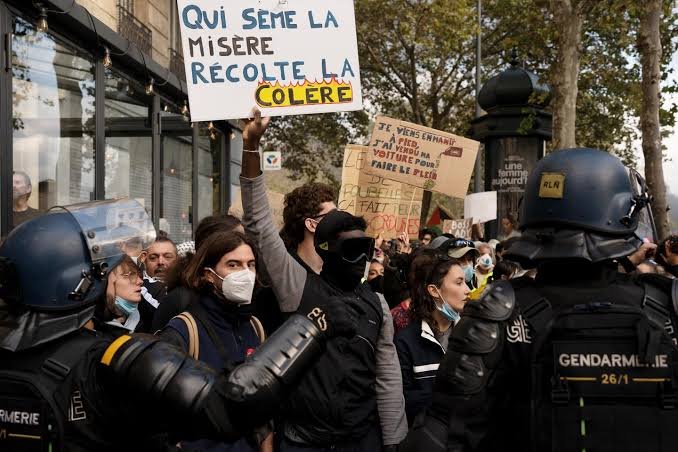
Protesters on the 17th of October 2026. Source: Adrienne Surprenant, Le Monde.
On the 17th of October 1961, in the final years of the Algerian war of independence, the FLN (National Liberation Front) called thousands of Algerian families to join them in a peaceful march across Paris. The chief of police Maurice Papon had imposed a curfew upon Algerians living in Paris following FLN attacks on police officers. The march was both in favour of an independent Algeria, and in protest of this curfew.
The movement was met by unthinkable police brutality. Members of the police force were reported to have shot, beaten and drowned demonstrators, continuing to hunt them in the following days and leaving those arrested to die in detention centres. The death toll is debated amongst historians, with estimates ranging between 30 and 300 casualties. This ambiguity comes from a lack of official documentation, as the French government scrambled to cover up the extent of the police violence, claiming the next day that only three had lost their lives.
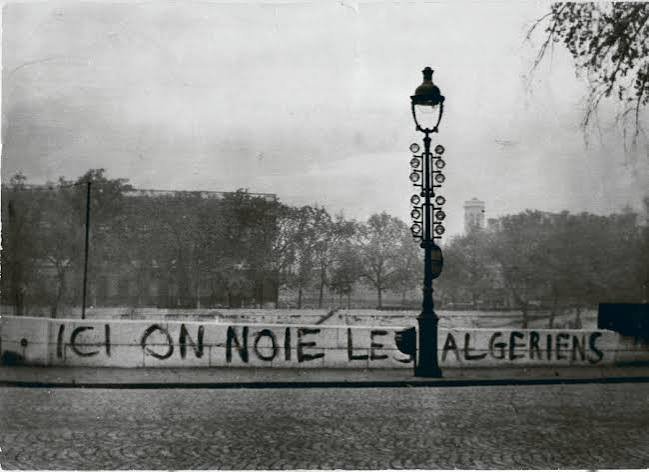
Graffiti from the aftermath of the massacre. Text reads ‘Here we drown Algerians’. Source: Jean Texier, L'Humanité.
Three casualties remained the official figure and the French government remained silent on the topic until 1998, when the event was finally acknowledged as a massacre by a government commission, and the official death toll was amended to forty-eight.
A plaque was unveiled in Paris on the 17th of October 2001, the first public recognition of the massacre. It read ‘In memory of the many Algerians killed during the bloody repression of the peaceful demonstration of 17 October 1961’. While a step in the right direction, the plaque was criticised for showing a lack of state accountability.
In 2012, on the 51st anniversary of the massacre, François Hollande became the first French president to speak publicly on the event: "On October 17, 1961, Algerians who were protesting for independence were killed in a bloody repression. The Republic recognizes these facts with lucidity." To many this statement lacked specificity, but it was generally seen as a welcome break from the silence of the French government on the topic of the massacre. Hollande was equally criticised by members of the right wing for his vague implication of state responsibility.
In 2021, on the 60th anniversary of the massacre, Emmanuel Macron issued a similar statement condemning the “inexcusable crimes” that took place in 1961. This too was met with criticism from both sides, with many still looking for an outright apology from the government and police force, and others accusing the president of falling for ‘anti-French’ sentiment.
Today, accurate commemoration of the massacre that took place on the 17th of October 1961 seems more important than ever. France is, at root, a revolutionary nation that strongly values the right to protest, but at the same time it is a nation with a forceful and ever-present police force. During the mobilisations of 2026, the massacre of 1961 has acted as a motivator for participation due to the symbolic status of the anniversary amongst a variety of groups, and serves as a reminder as to why the French will always proudly exercise their right to protest.
Edited by Sam Aylwin
Secondary literature :
https://www.jstor.org/stable/j.ctv1220kjn.10
https://www.jstor.org/stable/j.ctvwvr2vr.13
https://www.jstor.org/stable/20175152
https://www.jstor.org/stable/20175152
Further reading :
Paris Massacre of 17 October 1961 | DTiH
How a massacre of Algerians in Paris was covered up
Clashes erupt in France as protesters vow to make government 'tremble'
Why are French protesters chanting ‘Bismillah, c’est les ténèbres’? | Protests News | Al Jazeera