
By Maggie Butler, 3rd Year, History
Across France, a wave of student protests has been prompted by a nationwide strike and has dominated the media. But what is it all for? And is it indicative of a larger issue in France’s revolutionary history?
The uprisings stem from four main issues, according to the Union Syndicale Lycéenne (USL): teaching and staff shortages, overloaded classes, unsafe buildings, and grievances concerning the university admissions platform Parcoursup. The concerns displayed by the USL reflect a wider debate around the inequalities that exist within France’s education system. Students’ opportunities and experiences can vary considerably in relation to their social and economic background, and the resources available to their schools.
The protests have coincided with the unveiling of President Emmanuel Macron’s proposed 2027 budget, which has planned more severe budget cuts ahead of next year’s presidential election.[1] The conditions behind the students’ protests raise an uncomfortable question. France’s republican ideal of Liberté, Égalité, Fraternité promises a system of equality, but what happens when the quality of your education depends on where you live and the resources available to your school? Pair that with a lack of adequate government support, and it is unsurprising that students mobilised.
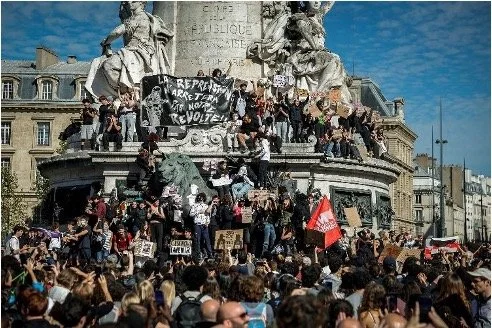
(Figure 1: Protesters gathered at Paris’s Place de la République on the 6th of October 2026. Credit: Geoffroy Van Der Hasselt)
The historical promise of education in France is a complicated story. One of the earliest examples of student protest comes from students at the University of Paris in 1229 – an early example of town and gown power struggles, which led to a strike that lasted over two years. Whilst higher education existed as a possibility in France, national public education only began to become a popular social and political issue during the French Revolution (1789-99). It was nearly a century later, after the Jules Ferry laws of 1881 and 1882, that primary secular education was made free and compulsory across France. The public school system seen today took another century to develop.
The Ferry laws marked a huge victory for the French Republic – universal public education was a significant political achievement and a long-term aim for the country. More reform followed, with the early twentieth century seeing welcome change in the mandatory minimum age to leave education and more funding allocated to the public education system. The gradual nationalisation of education in France became a source of national strength – but was it spearheaded for the purpose of genuine social equality, or to create a unified national identity to market the values of the state?
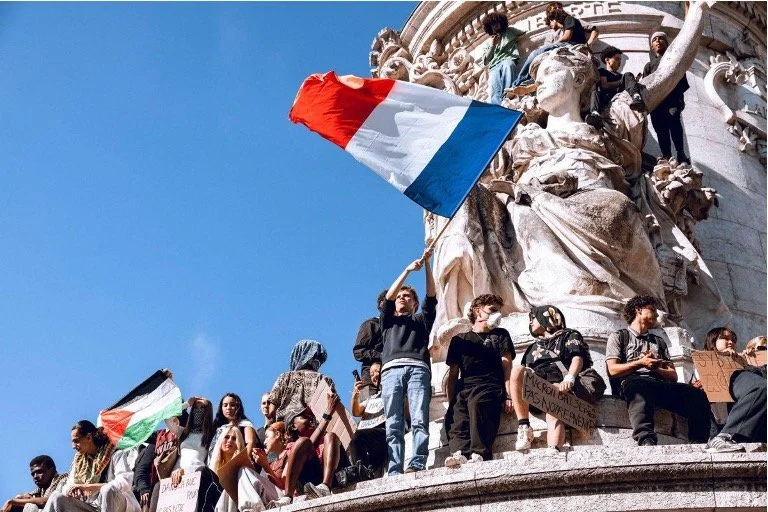
(Figure 2: Secondary school students display the French flag atop the Monument à la République in Paris, France on the 6th of October 2026. Credit: Sipa via Associated Press.)
The reality is that in twenty-first century France, complicated and systemic issues and disparities exist within the public education system, leaving it riddled with class inequalities and a problematic infrastructure.
According to the INSEE, among 25-34 year olds in 2024, 15% of children of manual workers had no diploma, or only a lower secondary school diploma (brevet), compared to 2% of children of managers or professionals. These social inequalities extend into higher education, with 83% of 25-34 year olds whose parents were managers or professionals holding a higher education degree, compared to 37% of young adults whose parents were manual workers.[2]
Whilst according to the OECD (Organisation for Economic Cooperation and Development), the French government spends more per lycée student than the EU average for upper-secondary schoolers, the budget is misdirected. Several students have shed light on the dilapidated physical infrastructure of schools across the nation, overwhelming class sizes of up to 40 students per classroom, and a significant lack of substitute teachers.[3]
The budget allocated to education by the French government does not equate to a better education in public schools, which exposes a tension between the Republic’s founding ideals and the experiences of the people it governs today. Whilst on paper the French government prioritises national education, students’ lived experiences seem to contradict those efforts and suggest that the spending has not delivered.
The significance of France’s student protests lies not just in the state of the education system, but in the expectations placed upon it. If public education is one of the Republic’s principal ideals of an equal state, persistent and historic differences in educational opportunity lead us to ask how fully that ideal has been realised.
Tension between the ideals of the French Republic and the lived experience is not a new phenomenon in France. Student protest has long proved a means of challenging the established political order in France, perhaps most famously the unrest of May 1968, when student demonstrations against government repression and university conditions in Paris sparked a nationwide strike. The uprising resulted in major labour agreements to improve the conditions for manual workers, and sweeping university reforms, which saw the monolithic University of Paris dissolved into thirteen independent campuses that better suited the student experience.
The reforms of May 1968 demonstrate a history of tense relations between the Republic and students of France. They suggest that the demonstrations taking place in France today are indicative of a larger, historic issue of neglect that does not align with the ideals of the French Republic.
‘Liberté, Égalité, Fraternité’ was a promise of a fairer republic, and universal education was meant to be one of the ways it was kept. Whether the cause is neglect or simply a system that has not kept pace with its own ideals, the Republic’s commitment to universal education has not eliminated the social inequalities embedded in its schools. From Paris in 1229 to May 1968, French students have used protest to hold the state to account. Today’s protests are the latest reminder that the promise of the Republic remains unfinished.
Edited by Kat Byrne
[1] Lucien Libert, ‘Student protest and public sector workers strike ahead of French budget,’ Reuters, Retrieved 4th October 2026. https://www.reuters.com/world/europe/student-protests-french-public-sector-strike-heap-pressure-macron-2026-09-29/
[2] INSEE, ‘Inégalités sociales dans l’enseignement scolaire,’ 2024, https://www.insee.fr/fr/statistiques/8612522
[3] ‘High school protests spread across France, pitting radical left against government,’ Le Monde, 29th Sep 2026