
By Kate Mellor, 3rd Year History
The nineteenth century marked a new age with regards to understandings of sex and reproduction. Having long been accepted simply as ‘natural’ processes, scientists increasingly sought to understand the biological processes which enable reproduction and creation. It was amongst this scientific discourse that Mary Shelley’s ‘Frankenstein’ emerged, as a literary exploration into the separation between sex and reproduction. ‘Frankenstein’ is one of the first texts, if not the first, to explore the idea that reproduction could occur without sexual intercourse.
The text raises questions about the potential dangers of scientific intervention in reproduction, preceding the twentieth-century debates around in vitro fertilisation (IVF) and genetic engineering by over a hundred years. Although it was ahead of its time, ‘Frankenstein’ presents an interesting opportunity to reflect on nineteenth-century understandings of reproduction, creation, and parenthood.
The plot centres around scientist Victor Frankenstein, who devises a radical way to create life, which completely sidesteps the usual prerequisites – pregnancy and childbirth. Victor becomes fixated on discovering the ‘secret of life’, and eventually he succeeds in creating a creature by assembling body parts from corpses. However, upon the creature’s completion, Victor is horrified by its appearance. He abandons his creation, leaving the creature to grow lonely – and vengeful.
Victor relocates procreation from the realm of the ‘natural’ to the domain of the ‘technological’ and faces disastrous consequences as a result. The novel raises questions about the potential drawbacks to creating life outside of ‘natural’ sexual boundaries. However, ultimately, parental love is framed as what is most fundamental to reproduction. It is not the absence of sex and conception that leads to the creatures’ monstrous tendencies, but its lack of parental affection and nurturing.
Throughout the novel, the absence of mothers has disastrous consequences. Victor Frankenstein’s mother passes away at a young age, instilling in him a fascination with mortality, and therefore prompting his experiments with reproduction. Similarly, the creature is not initially a ‘monster’; it is only by depriving the creature of love and nurturing that Victor inadvertently creates a villain. Through these plot points, Richard Gunderman says, ‘Shelley reminds us that the genius of motherhood lies less in biological reproduction than in the capacity to love’. In other words, the separation of sex and reproduction is disastrous, because it deprives the creature of love and tenderness. It is perhaps not surprising that Shelley explores the importance of motherhood in this way, having lost her own mother to childbirth complications.
The novel presents Victor’s pursuit of scientific reproduction as inherently masculine, and ‘natural’ reproduction as innately feminine. Victor relishes accomplishing what many men before him had failed to do. Victor himself views ‘natural’ reproduction as feminine, stating that he ‘pursued nature to her hiding place’. It is these gendered conceptions of reproduction that have led feminist scholars to read the novel as a critique of patriarchal ambition. Anne K. Mellor, for example, argues that ‘Frankenstein’ is a deeply feminist novel which critiques masculinity, patriarchal scientific institutions, and male fantasies of creation. Not only does Victor remove the need for women’s involvement from reproduction, but he also refuses to produce a female companion for the creature out of fear that the two would reproduce:
“Yet one of the first results of those sympathies for which the daemon thirsted would be children, and a race of devils would be propagated upon the earth” (‘Frankenstein’, 1816)
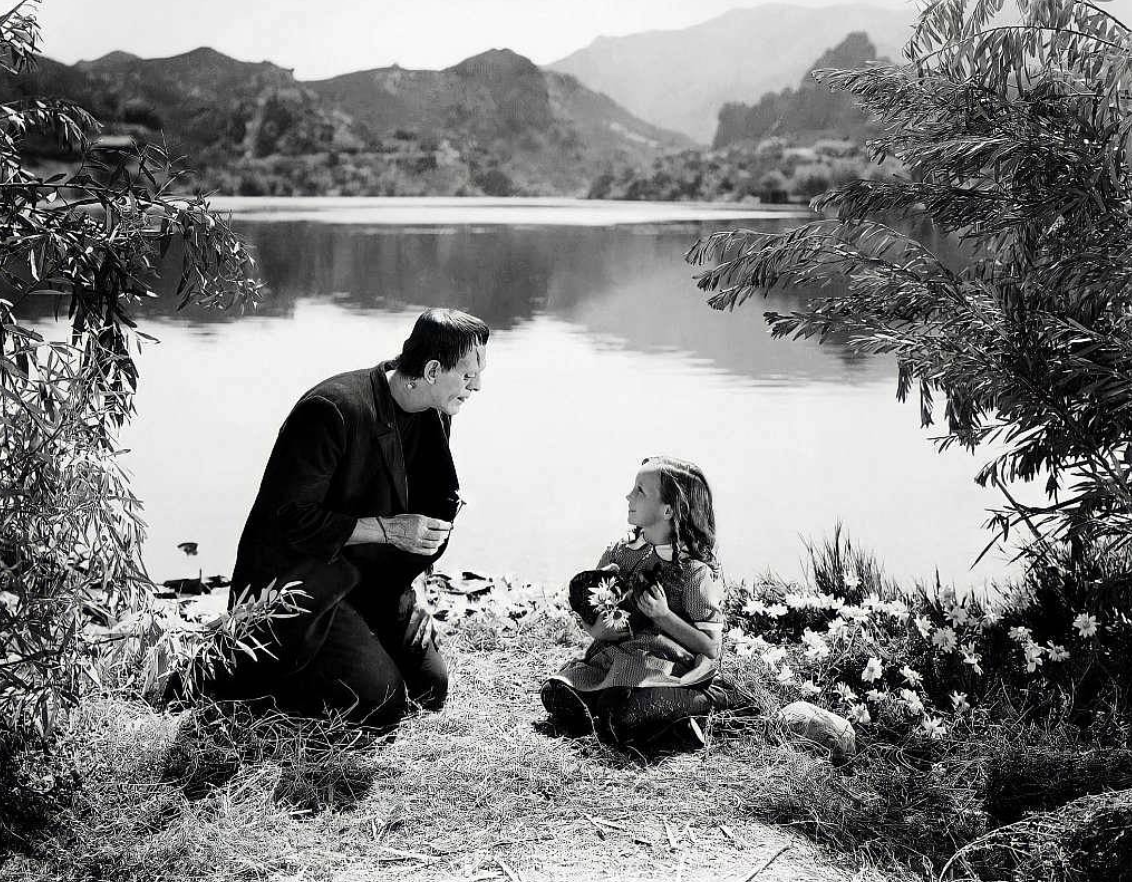
Boris Karloff as the Creature with Marilyn Harris as Maria, in ‘Frankenstein’ (1931)
According to feminist scholars, Victor is fearful of women’s reproductive power. In his vision, men create men, a vision of the ultimate patriarchal society where women cease to exist. Not only are women absent from reproduction, but they are also largely excluded from the novel as a whole, with most of the female characters being killed. Shelley critiques and undermines this vision of the ultimate patriarchal society through the tragic downfall of Victor and his creature.
“A new species would bless me as its creator and source; many happy and excellent natures would owe their being to me”. (‘Frankenstein’, 1818)
Victor is deeply ambitious and arrogant and so he utterly fails to foresee the consequences of his actions. Despite believing he has the capacity to successfully produce life, his actions ultimately lead to the death of his loved ones and the existence of an unloved and bitter creature.
Shelley’s exploration of the distinction between sex and reproduction reflected contemporary scientific research and anticipated modern debates around assisted reproduction. Victors’ abandonment of the creature demonstrates the limits of reproduction when it is rooted in masculine ambition and possibly offers a critique of the misogyny within science as a discipline. Ultimately though, ‘Frankenstein’ suggests the real issue lies not in the separation of sex from reproduction, but in creation without love, compassion or nurture. This, to a large degree, reflects the modern consensus, according to which parental nurture is far more important to rearing a child than it being conceived ‘naturally’.
Edited by Zoe Lambe